
A World Gone Corrupt
Noach (Noah) is a righteous man, wholehearted in his generation, who walks with God while the world around him fills with violence and corruption. God sees that the earth has become ruined and tells Noach that a flood is coming to wash it clean. God instructs him to build a teivah (an ark) of gopher wood, sealed with pitch, with careful dimensions and many rooms, large enough to carry his family and pairs of every living creature. Noach is to bring his wife, his three sons Shem, Cham (Ham), and Yefet (Japheth), and their wives, along with food for them all. Noach does everything exactly as God commands him.
The Great Flood
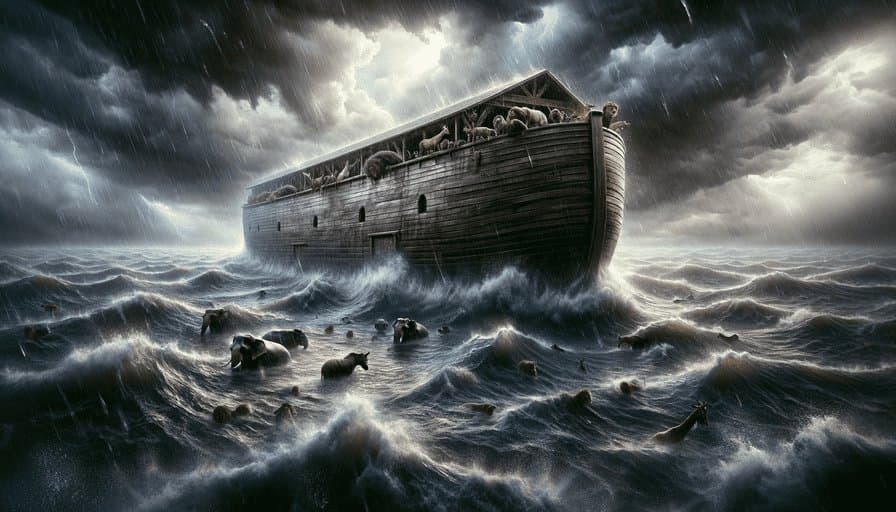
When all is ready, God brings Noach and his household into the ark, together with the animals, and seals them inside. The rains fall for forty days and forty nights, and the waters of the deep burst upward until the entire earth is covered and even the mountains disappear. Every living thing on dry land perishes, and only those within the ark survive. The waters remain high upon the earth for many months, and the small wooden vessel drifts alone over a drowned world.
The Dove Returns
God remembers Noach and all who are with him, and sends a wind so the waters begin to recede. The ark comes to rest on the mountains of Ararat, and Noach sends out a raven and then a dove to see whether the ground has dried. The dove returns the first time, comes back with an olive leaf the second time, and on the third does not return at all, a sign that the earth can be lived on again. When the ground is finally dry, God tells Noach to leave the ark with his family and every creature. Noach builds an altar and offers sacrifices, and God accepts them, resolving in His heart never again to destroy all life because of humanity.
The Rainbow Covenant
God blesses Noach and his sons and tells them to be fruitful and to fill the earth once more. He permits human beings to eat the flesh of animals but forbids consuming blood, and He declares the sacredness of human life, for every person is made in the image of God. Then God makes a covenant with Noach and with all living things, promising that never again will a flood destroy the earth. As the sign of this eternal promise, God sets the rainbow in the clouds, a reminder to every generation that mercy holds back judgment.
Noach's Vineyard
After the flood, Noach becomes a man of the soil and plants a vineyard. He drinks of its wine, becomes drunk, and lies uncovered inside his tent. His son Cham sees his father's disgrace and tells his brothers, but Shem and Yefet take a garment, walk in backward, and cover their father without looking at him. When Noach awakens and learns what has happened, he curses Cham's son Canaan to servitude and blesses Shem and Yefet. Noach lives a long life after the flood and dies at the age of nine hundred and fifty.
Nations and the Tower
The Torah traces how the sons of Noach branch out into the seventy families and nations that spread across the earth, each with its own lands and languages. In time all the people share one language and settle together in the plain of Shinar. There they resolve to build a city and a tower reaching to the heavens, to make a name for themselves and to keep from being scattered. God sees their pride and confuses their single language into many, so they can no longer understand one another, and He disperses them across the face of the earth. The place is called Bavel, because there God confused the one speech of all the world.
The Line of Avram
The parsha closes by following the generations from Shem down through the years to a man named Terach (Terah). Terach fathers three sons, among them Avram, who marries Sarai, a woman who is unable to have children. Terach gathers Avram, Sarai, and his grandson Lot and sets out from Ur Kasdim (Ur of the Chaldees) toward the land of Canaan. Along the way they settle in a place called Charan, and there Terach lives out his remaining years and dies. The stage is quietly set for Avram, whose own journey begins in next week's parsha, Lech-Lecha.