
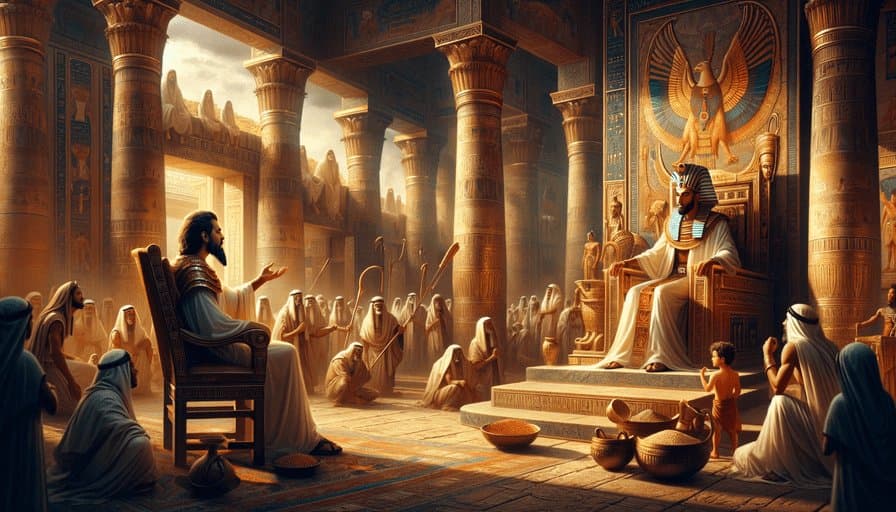
Pharaoh's Dreams
Two full years pass, and one night Par'oh dreams that seven healthy cows come up from the Nile, only to be swallowed by seven gaunt and ugly ones. He dreams again of seven full ears of grain devoured by seven thin, scorched ears, and he wakes deeply troubled. None of Egypt's magicians or wise men can interpret the dreams to his satisfaction. At last the chief cupbearer remembers the young Hebrew who had interpreted his own dream in prison, and he tells the king about Yosef.
From Prison to Palace
Yosef is rushed from the dungeon, shaved and dressed in fresh clothes, and brought before Par'oh. He insists that the power to interpret comes not from himself but from God, then explains that both dreams carry a single message: seven years of great abundance will be followed by seven years of devastating famine. He advises Par'oh to appoint a wise man to gather and store grain during the years of plenty so that Egypt can survive the years of hunger. Impressed by his wisdom, Par'oh sets Yosef himself over all of Egypt, giving him the royal signet ring, fine linen, and a gold chain, making him second in command only to the throne.
Plenty and Famine
Yosef, now thirty years old, travels throughout Egypt and gathers grain during the seven abundant years until it is beyond measure. His wife Asnat (Asenath) bears him two sons, Menashe (Manasseh) and Efrayim (Ephraim), whose names reflect both the pain he has left behind and the blessing he has found. When the seven good years end, famine strikes every land, but Egypt alone has stores of food. From all directions people stream to Egypt to buy grain, and Yosef is the one who sells it to them.
The Brothers Bow
Back in Canaan the famine bites hard, and Yaakov (Jacob) sends ten of his sons down to Egypt to buy grain, keeping the youngest, Binyamin (Benjamin), safely at home. The brothers bow low before the Egyptian ruler, not recognizing that he is Yosef, though he knows them at once. He speaks harshly, accuses them of being spies, and demands that they prove their honesty by bringing their youngest brother to Egypt. He holds Shimon (Simeon) as a hostage and secretly orders their payment returned inside their sacks, and when they discover it on the way home their hearts sink with fear. They report everything to Yaakov, who refuses to let Binyamin go.
Binyamin Goes Down
When the grain runs out and the famine grows worse, Yehuda (Judah) personally guarantees Binyamin's safety, and Yaakov reluctantly sends the boy along with gifts and double the silver. Arriving in Egypt, the brothers are brought to Yosef's house, and when Yosef sees Binyamin, his own mother's son, he is so moved that he hurries out to weep before composing himself. He hosts them at a lavish meal, seating them in the exact order of their ages, which leaves them astonished, and he gives Binyamin a portion five times larger than the others. For a moment the brothers eat and drink with him at ease, unaware of what is coming.
The Hidden Goblet
Yosef instructs his steward to fill the brothers' sacks with food, return their money again, and hide his own silver goblet in Binyamin's sack. Soon after they leave, the steward overtakes them and accuses them of stealing the goblet, and so sure are they of their innocence that they declare the guilty one deserves to die. The cup is found in Binyamin's sack, and the brothers tear their clothes in horror and return to the city. Yosef declares that only the one in whose possession the goblet was found will become his slave, while the rest may go home. The parsha ends on this knife's edge, with Binyamin's freedom and the whole family's future hanging in the balance.