
On the Way to Esav
As Yaakov nears home, he sends messengers ahead to his brother Esav, who is living in the land of Seir. Word comes back that Esav is approaching with four hundred men, and Yaakov is gripped with fear. He divides his household into two camps so that if one is attacked the other might escape, and he pours out a prayer to God, recalling the promise of protection and admitting that he is unworthy of all the kindness he has received. Then he prepares a generous gift of flocks and herds, sending them ahead in waves to soften his brother's heart before they meet.
Wrestling Until Dawn
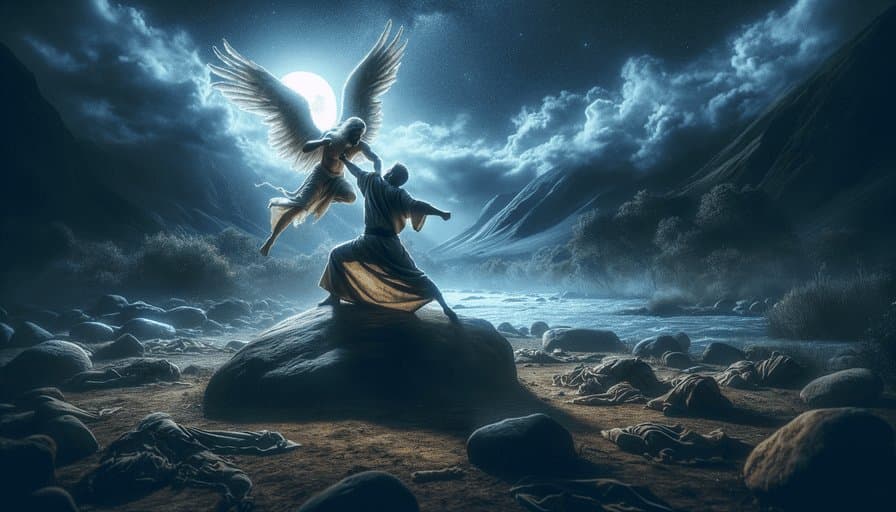
That night Yaakov sends his family across the river and remains alone, and a mysterious man wrestles with him until the break of day. Unable to overcome him, the stranger strikes Yaakov's hip, wrenching it from its socket, yet Yaakov holds on and refuses to let go without a blessing. The being gives him a new name, Yisrael, meaning one who has struggled with God and with people and has prevailed. Yaakov names the place Peniel, for he has seen the divine face and survived, and he walks on limping from the injured sinew, which is why the people of Israel do not eat that sinew to this day.
The Brothers Embrace
At dawn Yaakov sees Esav coming and arranges his family, then walks ahead and bows to the ground seven times. To his relief, Esav runs to meet him, embraces him, and weeps on his neck, all the old hatred melted away. Esav at first declines the gift, saying that he has plenty, but Yaakov presses him until he accepts. The brothers part in peace, Esav returning to Seir while Yaakov journeys on to Sukkot and then to the city of Shechem, where he buys a parcel of land and builds an altar to God.
Sorrow at Shechem
Yaakov's daughter Dinah goes out to visit the women of the land, and Shechem, the prince of the region, seizes and violates her, then longs to take her as his wife. Deeply pained, Dinah's brothers answer the marriage proposal with deceit, agreeing only if every male of the city is circumcised. On the third day, while the men are still in pain, Shimon (Simeon) and Levi enter the city and kill all the males, rescuing their sister, and the other brothers take the spoil. Yaakov rebukes them for making the family hated among their neighbors, but they answer that their sister should not be treated like a harlot.
Return to Beit El
God tells Yaakov to go up to Beit El (Bethel) and build an altar there, and Yaakov first purges his household of every foreign idol, burying them beneath a tree. At Beit El God appears to him once more, confirms the name Yisrael, and renews the covenant of land and countless descendants first given to Avraham (Abraham) and Yitzchak. As they travel on, Rachel goes into hard labor and dies giving birth to Yaakov's twelfth son, Binyamin (Benjamin), and Yaakov buries her on the road to Efrat (Bethlehem) and sets a pillar over her grave. The Torah then lists the twelve sons of Yaakov, the tribes from whom the whole people will descend.
Yitzchak's Passing and Esav's Line
Yaakov finally returns to his father Yitzchak at Hebron, and Yitzchak dies at the age of one hundred and eighty, mourned and buried by both his sons together. The parsha then closes with a long account of the descendants of Esav, who is also called Edom, listing his sons, the tribal chiefs, and the kings who reign in his land. This careful record honors Esav's family even as the Torah's main story turns toward the children of Yisrael. It reminds us that Esav too becomes a great nation, just as God had promised.