
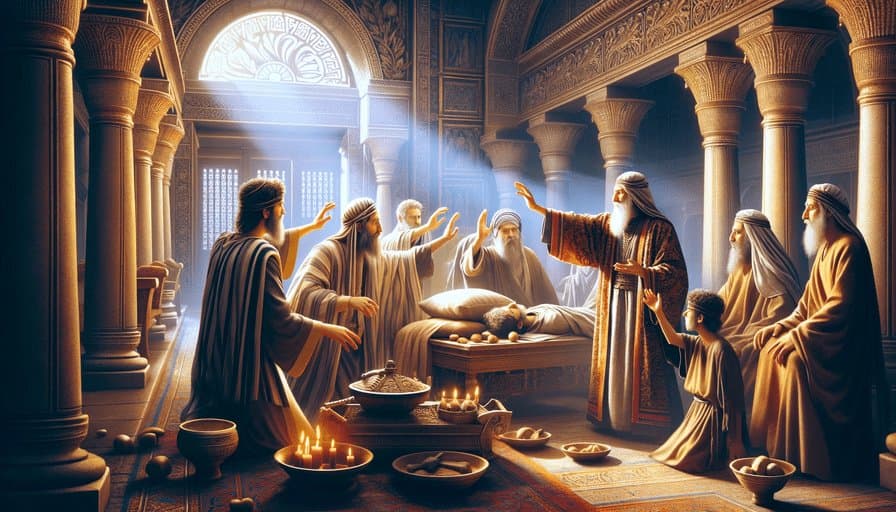
A Final Request
Yaakov lives seventeen years in Egypt, reaching the age of one hundred and forty-seven, and as he senses his death drawing near he calls for his son Yosef. He makes Yosef swear a solemn oath not to bury him in Egypt but to carry his body back to the ancestral burial place in the land of Canaan. Yosef promises to do as his father asks, and Yaakov, reassured, bows at the head of his bed. The dying patriarch's thoughts are already turning homeward, toward the land God promised to his family.
Crossed Hands
Hearing that his father is ill, Yosef brings his two sons, Menashe (Manasseh) and Efrayim (Ephraim), to receive a blessing, and Yaakov declares that these grandsons will count among his own children, each the head of a tribe. As Yaakov reaches out, he crosses his hands, placing his right hand on the younger Efrayim and his left on the firstborn Menashe. Yosef tries to switch them, but his father gently refuses, explaining that although both will be great, the younger brother will become greater still. Yaakov blesses them with the very words that Jewish parents still say over their sons to this day, that God make them like Efrayim and Menashe.
The Blessings of the Twelve
Yaakov then gathers all twelve of his sons around him to tell them what will befall them in the days to come. One by one he speaks to each, matching his words to the character of the son before him: he reproves Reuven (Reuben) for his instability and Shimon (Simeon) and Levi for their anger, while he grants Yehuda (Judah) the scepter of kingship, comparing him to a lion. He foretells Zevulun (Zebulun) dwelling by the sea, blesses Yosef as a fruitful vine watched over by God, and likens Binyamin (Benjamin) to a wolf, giving every tribe its own destiny and role among the people. These are the last words of a father shaping the future of a nation through his children.
Yaakov's Passing
When he finishes, Yaakov instructs all his sons to bury him in the Cave of Machpelah in Canaan, where Avraham (Abraham) and Sarah, Yitzchak (Isaac) and Rivka (Rebecca), and Leah are already buried. Then he draws his feet up into the bed, breathes his last, and is gathered to his people. Yosef weeps over his father and has him embalmed, and all of Egypt mourns him for seventy days. A great procession of family and Egyptian dignitaries carries Yaakov up to Canaan, buries him in the ancestral cave as he wished, and then returns to Egypt.
You Meant It for Good
With their father gone, the brothers grow afraid that Yosef will finally take revenge for what they did to him long ago. They send him a message that Yaakov had asked him to forgive them, and they come and fall down before him, offering to be his slaves. Yosef weeps and gently reassures them, asking whether he is in the place of God to judge them. What you intended for harm, he tells them, God intended for good, to bring about the survival of many people. He speaks kindly to them and promises to care for them and their children.
The End of Genesis
Yosef lives to the age of one hundred and ten and sees his great-grandchildren grow up around him. As his own death nears, he gathers his brothers and assures them that God will surely remember them and bring them up out of Egypt to the land promised to Avraham, Yitzchak, and Yaakov. He makes them swear that when that day of redemption comes, they will carry his bones up with them out of Egypt. Yosef dies, is embalmed, and is placed in a coffin in Egypt, and with this promise of a future homecoming the Book of Genesis comes to a close.