
From Family to Nation
The book opens by listing the names of Yaakov's sons who came down to Egypt, seventy souls in all. That generation dies, but the children of Israel are fruitful and multiply until they fill the land. Then a new king arises who did not know Yosef (Joseph), and fearing their growing numbers, he enslaves them with crushing labor, forcing them to build the store cities of Pithom and Ramses. Yet the more Egypt oppresses them, the more the people increase, until the Egyptians come to dread them.
Pharaoh's Cruel Decree
Determined to break the people, Par'oh commands the Hebrew midwives, Shifra (Shiphrah) and Puah, to kill every baby boy at birth. But the midwives fear God more than they fear the king, and they let the children live, so God rewards them with households of their own. Frustrated, Par'oh issues a decree to his whole nation: every Hebrew baby boy is to be cast into the Nile, while the girls may live. The shadow of this terrible decree hangs over the birth of the very child who will become Israel's deliverer.
Drawn from the Water
A man and woman of the tribe of Levi have a son, and seeing how good he is, the mother hides him for three months. When she can hide him no longer, she places him in a waterproofed basket among the reeds at the river's edge. Par'oh's own daughter comes down to bathe, finds the basket, and takes pity on the crying infant, even though she recognizes him as a Hebrew child. The baby's sister, Miriam, who has been watching nearby, offers to find a Hebrew nurse and cleverly brings the child's own mother, and once he is grown the princess names him Moshe and raises him as her son in the palace.
Exile in Midian
When Moshe is grown, he goes out to his people and sees an Egyptian beating a Hebrew slave, and looking about, he strikes the Egyptian down and hides him in the sand. The next day he tries to stop two Hebrews fighting, and one of them sneers, asking whether Moshe means to kill him as he killed the Egyptian. Realizing the deed is known, and with Par'oh seeking his life, Moshe flees to the land of Midian, where he defends the daughters of the priest Yitro (Jethro) at a well and waters their flock. He marries Yitro's daughter Tzipporah (Zipporah) and has a son named Gershom, while back in Egypt the old king dies and the people cry out under their slavery, and God hears them and remembers His covenant.
The Burning Bush
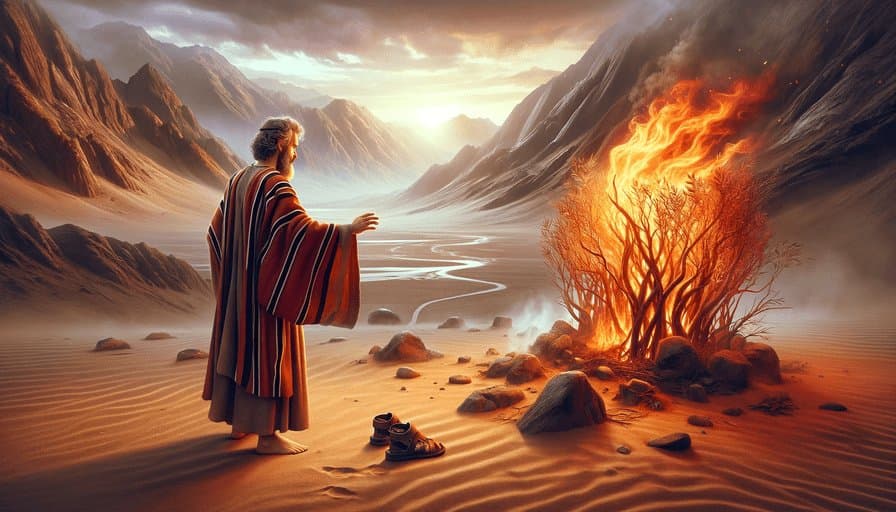
Shepherding Yitro's flock, Moshe comes to Chorev (Horeb), the mountain of God, and sees a bush that burns with fire yet is not consumed. From within the bush God calls his name, tells him to remove his sandals because the ground is holy, and reveals Himself as the God of Avraham (Abraham), Yitzchak (Isaac), and Yaakov. God declares that He has seen the suffering of His people and will bring them out of Egypt to a good and spacious land flowing with milk and honey, and He sends Moshe to Par'oh to free them. When Moshe asks by what name he should speak of Him, God answers with the mysterious words Ehyeh Asher Ehyeh, I Will Be What I Will Be, the God of their fathers who now acts to redeem them.
A Reluctant Messenger
Moshe hesitates, protesting that the people will not believe him, so God gives him three signs: his staff turns into a serpent and back again, his hand becomes leprous and is healed, and water from the Nile turns to blood. Still Moshe objects that he is slow of speech and not a man of words, until God, somewhat displeased, appoints his brother Aharon (Aaron) to speak on his behalf. Moshe takes leave of his father-in-law Yitro and sets out for Egypt with the staff of God in his hand. God warns him that Par'oh's heart will be hardened, and that he must tell Par'oh that Israel is God's firstborn son, whom he must release or lose his own firstborn.
Return to Pharaoh
Aharon goes out to meet Moshe, and together they gather the elders of Israel, where Aharon repeats God's words and performs the signs, and the people believe and bow in worship that God has remembered them. Moshe and Aharon then stand before Par'oh and deliver God's demand to let His people go, but Par'oh scoffs, asking who this God is that he should obey Him, and refuses. Instead he makes the slavery even crueler, ordering the people to gather their own straw while still producing the same number of bricks, and when they fall short their foremen are beaten. The foremen turn bitterly on Moshe and Aharon, and Moshe cries out to God, who answers that now Moshe will see what He will do, for with a strong hand Par'oh will be forced to let them go.