
Drawing Near After Loss
The parsha begins by recalling the death of Aharon's (Aaron's) two sons, who drew too close to the divine presence, and God speaks to Moshe (Moses) with a warning born of that loss. Aharon may not enter the Holy of Holies, the innermost chamber where God's presence rests above the Ark, whenever he wishes. Only on one appointed day, and only through a carefully ordered service, may he pass beyond the veil and live. Nearness to God, the Torah teaches, is a gift of immense power that must be approached with reverence rather than seized.
The Day of Atonement
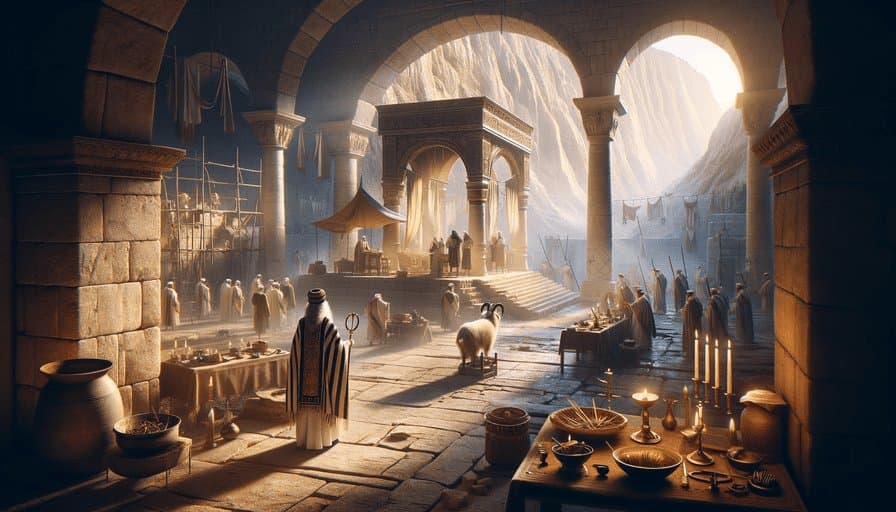
God details the service of Yom Kippur, the Day of Atonement. Aharon sets aside his golden garments for simple white linen, offers a bull to atone for himself and his household, and takes two goats for the people. Lots are cast over the goats: one is offered to God as a sin offering, and the other, bearing the confessed sins of the people, is sent away into the wilderness to Azazel. Aharon enters the Holy of Holies with a cloud of incense and sprinkles blood to purify the sanctuary, and the Torah establishes this as an eternal statute: on the tenth day of the seventh month the people afflict themselves and rest, and atonement is made for all Israel.
One Place for Offerings
The Torah then forbids the people from slaughtering offerings wherever they please, as they might in the open field. Every offering must be brought to the entrance of the Tent of Meeting, so that worship is directed to God alone and not to the goat-demons that some were tempted to serve in the wilderness. By gathering all sacred service to one place, the Torah protects the people from drifting back into the practices of the surrounding nations. Worship, it insists, is not a private invention but a shared turning toward the one God.
The Life in the Blood
The parsha teaches that the people may not consume blood, for the life of every creature is bound up in its blood, which God has given upon the altar as the means of atonement. One who hunts a bird or animal for food must pour out its blood and cover it with earth, treating even an ordinary meal with reverence for the life it required. These laws instill a deep respect for life and for the mystery that a creature's very vitality carries. To eat with awareness, the Torah suggests, is itself a form of holiness.
The Sanctity of Family
The parsha closes with the laws that guard the intimacy of family life, forbidding relationships that would violate its trust and sanctity. God frames these laws by contrasting them with the ways of Egypt, where Israel had lived, and Canaan, where they are going, and calls the people instead to walk in His statutes and live. The Torah warns that such violations defile a land until it can no longer bear its inhabitants, and urges Israel to guard these boundaries and remain distinct. Holiness, here, reaches into the most private corners of human life and asks that they too be kept faithful.