
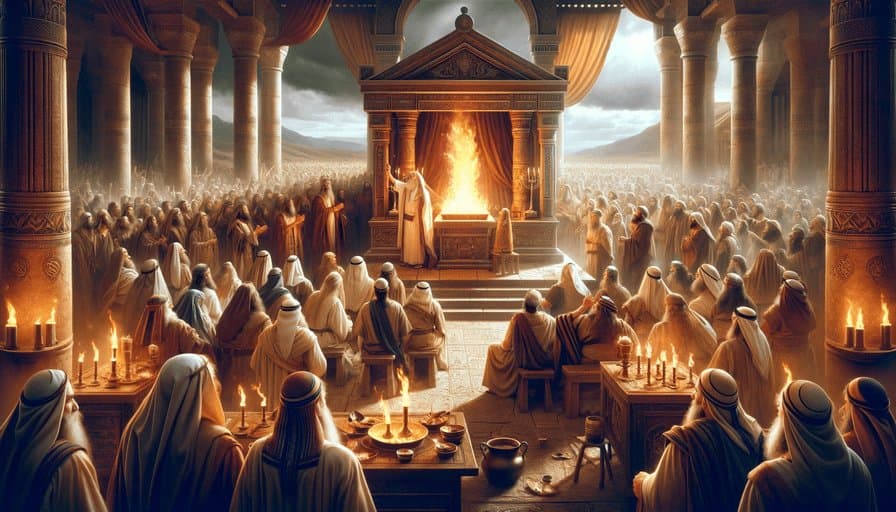
The Eighth Day
After seven days of preparation, the eighth day arrives and Aharon steps forward to begin his service as high priest. Following Moshe's (Moses) instructions, he brings offerings for himself and for the people, seeking atonement and blessing at the very start of the sanctuary's life. Moshe and Aharon bless the people, and the glory of God appears to the entire nation. Then fire comes forth from before God and consumes the offerings upon the altar, and the people shout for joy and fall on their faces. Heaven itself has answered, and the Mishkan (Tabernacle) is filled with the divine presence.
Strange Fire
In the midst of this joy, Aharon's two elder sons, Nadav and Avihu, take their fire pans and offer a strange fire before God that had not been commanded. Fire comes forth again from before God, but this time it consumes them, and they die in the very sanctuary they served. Moshe tells his brother that God had spoken of being sanctified through those nearest to Him. In the face of unspeakable loss, Aharon is silent, and his stillness is a response deeper than any words.
In the Wake of Grief
The bodies of the young men are carried outside the camp, and Aharon and his remaining sons, Elazar and Itamar, are told to continue their sacred duties rather than interrupt the sanctuary's first day with public mourning. God commands that the priests never enter the sanctuary having drunk wine, so that they can distinguish the holy from the ordinary and teach the people clearly. A dispute then arises over an offering that was burned rather than eaten, and when Aharon explains his reasoning on this day of sorrow, Moshe accepts his words. Even amid grief, the service of God is carried out with clarity and care.
Clean and Unclean
The parsha turns to the laws of which animals the people of Israel may eat. Among land animals, only those that both chew the cud and have fully split hooves are permitted, and the Torah names familiar creatures that bear one sign but not the other. Those that live in the water must have fins and scales to be eaten, and a list of forbidden birds is given, along with the rules for flying insects. These distinctions turn the daily table into a place where holiness is practiced.
A Holy People
The Torah details how contact with the carcasses of certain creatures conveys impurity, reaching even the vessels and ovens of a household, and it addresses the small creatures that creep upon the earth. Running through all of it is a single calling: the people are to make themselves holy and to be holy, because God is holy. The chapter closes by naming its own purpose, to distinguish between the impure and the pure and between the creature that may be eaten and the one that may not. Holiness, the parsha teaches, is built not only in grand moments but in the ordinary choices of every day.