
After Childbirth
The parsha opens with the woman who has brought new life into the world. After giving birth she enters a period of ritual impurity followed by a longer span of purification, a set-apart time that the Torah treats with quiet dignity as she stands at the very threshold of life and death. When those days are complete, she brings an offering to the entrance of the sanctuary, and if her means are limited the Torah provides a gentler path of two birds. The parsha also notes that a son is to be circumcised on the eighth day, entering the covenant even as his mother's own days of purity continue.
Reading the Signs
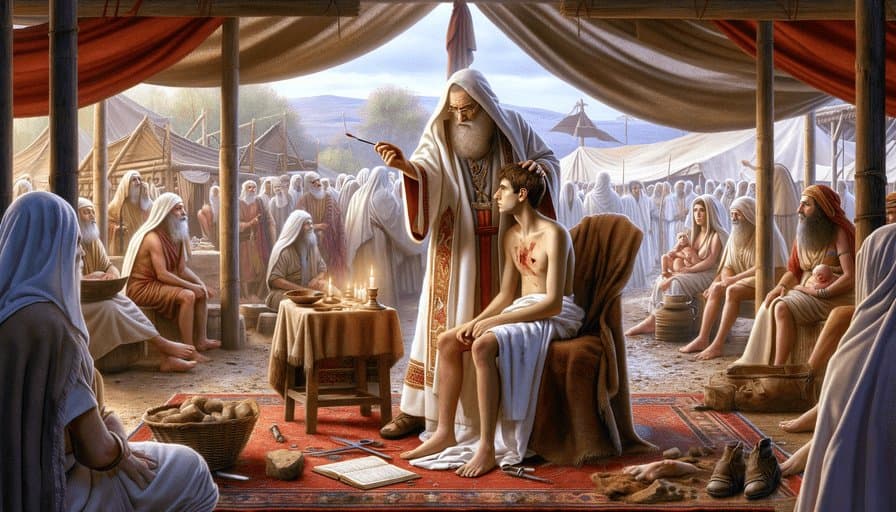
The Torah turns to tzara'at, an affliction that appears as a discoloration or swelling upon a person's skin. Anyone who notices such a mark is brought to the Kohen, whose trained eye alone can declare the person pure or impure. Rather than rush to judgment, the priest may set the person apart for seven days and look again, and then a second seven, watching whether the sign has spread or faded. The care of this examination reflects a truth at the heart of the parsha: a person in distress is never dismissed, but attended to patiently by one whose calling is blessing and peace.
Body and Skin
The Torah describes a range of further cases, including marks that arise where a boil or a burn has healed and afflictions that appear on the head or in the beard. It distinguishes the true sign of tzara'at from ordinary changes of the skin and from simple baldness, guiding the Kohen through each situation. The tradition understands tzara'at not as a random illness but as an outward sign of inward matters, often linked to harmful speech and to a heart turned away from others. Seen this way, the affliction becomes an invitation to reflection rather than a mark of shame.
Dwelling Apart
When a person is declared to bear tzara'at, the Torah asks him to let his hair grow, to tear his garments, to cover his upper lip, and to call out so that others may keep their distance. He dwells alone, outside the camp, for the duration of his affliction. This separation is not a shame to be hidden but a time set aside for honest reckoning and eventual return, and the tradition takes great pains to guard the dignity of the one who endures it. Even in solitude, he remains a member of the community that awaits his healing.
When Cloth Is Afflicted
The parsha closes with tzara'at that appears not on a person but in a garment of wool, linen, or leather. The Kohen examines the greenish or reddish stain, sets the garment aside for seven days, and watches whether it spreads. Depending on what he finds, the affected part may be washed and set apart again, torn out, or the whole garment burned. That the affliction can reach even into a person's belongings extends the parsha's call: what troubles the soul can leave its trace on the world around us, and each trace is an invitation to look inward.