
Holiness of the Priests
The parsha opens with laws that set the kohanim (the priests) apart for their sacred service. Because they minister in the sanctuary, ordinary priests may not come into contact with the dead except for their closest relatives, and they are held to special standards in whom they may marry. The Kohen Gadol (the High Priest) lives by an even higher measure of holiness, kept apart from the mourning practices that would compromise his role. A priest with a physical blemish, though fully part of the sacred family and entitled to eat its holy food, does not perform the offerings at the altar. Together these laws frame the priesthood as a life of heightened dignity and discipline.
Gifts and Offerings
Attention turns to the sacred gifts the priests receive and the animals brought as offerings. A priest must be in a state of purity to eat the holy portions, and those outside the priestly household may not share in them. Animals offered to God must be unblemished and whole, since a defective gift dishonors the One to whom it is brought, and a newborn animal must stay with its mother seven days before it may be offered. The Torah forbids slaughtering an animal and its young on the same day, and it warns the priests again and again not to desecrate God's holy name but to sanctify it before the people.
The Sacred Calendar
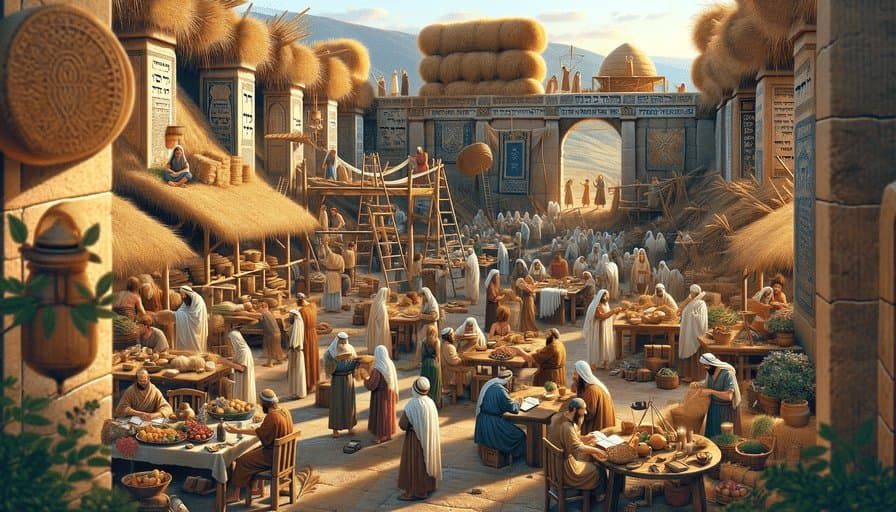
The parsha then unfolds the great calendar of holy days, the moadim (the appointed festivals). It begins with the Sabbath, the weekly foundation of sacred time, and moves through the year: Pesach (Passover) and its seven days of matzah, the counting of the Omer that leads up to Shavuot, the day of the shofar known as Rosh Hashanah (the New Year), the solemn fast of Yom Kippur (the Day of Atonement), and the joyful week of Sukkot. Israel is commanded to take up the four species and to dwell in booths for seven days, recalling the shelter God provided in the wilderness. Together these days form a rhythm of memory, gratitude, and renewal that still shapes Jewish life today.
Light and Bread
From the calendar the parsha moves to two constant fixtures of the sanctuary. Israel is commanded to bring pure, clear olive oil so that Aharon (Aaron) may kindle the lamps of the menorah to burn continually, a steady light before God. On the golden table, twelve loaves of showbread are arranged in two rows and renewed every Sabbath, a lasting offering that represents the twelve tribes. These quiet, ongoing rituals express a bond with God that is not confined to festivals but sustained day after day.
Justice in the Camp
The parsha closes with a troubling episode. A man of mixed Israelite and Egyptian parentage quarrels in the camp and curses the name of God, and he is placed in custody until God's judgment can be made clear. Through this case the Torah sets out foundations of justice: one who blasphemes bears responsibility, one who takes a human life is held to account, and one who kills an animal must make restitution. The well-known principle of measure for measure, an eye for an eye, teaches that justice must be exact and proportional, and that a single law binds citizen and stranger alike. The reading ends as the sentence is carried out, sealing the parsha's vision of a community governed by holiness and fairness.