
Blessing and Curse
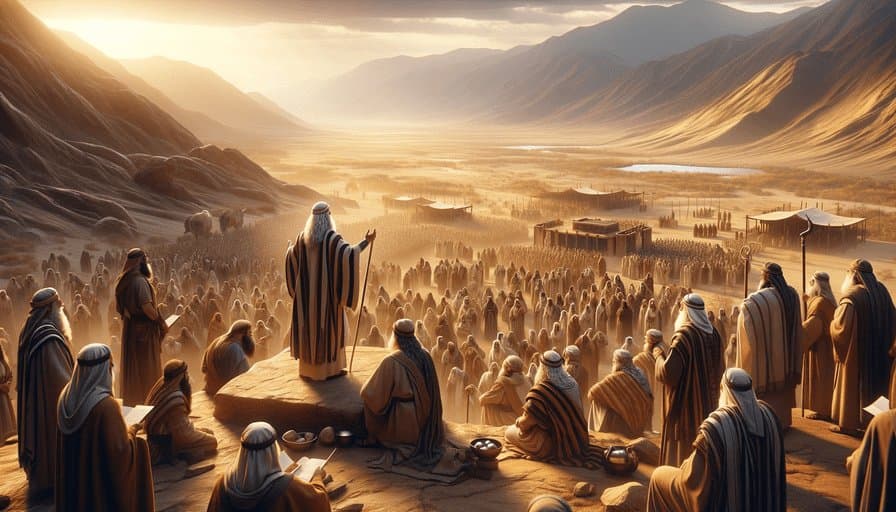
Moshe (Moses) opens by placing before the people a blessing and a curse: blessing if they listen to God's commandments, and curse if they turn away to follow other gods. He tells them that when they cross into the land they are to enact this choice aloud, proclaiming the blessings upon Mount Gerizim and the curses upon Mount Eival (Ebal). The scene frames everything that follows, casting the whole body of law not as a burden but as a path toward the good life God desires for them. To live by the covenant is to choose blessing.
One Place of Worship
Moshe commands the people to tear down every altar and shrine the nations used for idolatry, leaving no trace of those practices in the land. Instead of worshiping God wherever they please, they are to bring their offerings, tithes, and gifts to the one place God will choose to rest His name, the site that will one day be Jerusalem. Moshe explains that ordinary meat may now be eaten anywhere once they are settled, but the blood must never be consumed, for the blood is life. Worship, he teaches, is not to be scattered and improvised but centered and holy.
Guarding Against Idolatry
Moshe warns the people not to be curious about how the nations served their gods, lest they be drawn into the same abominations. He describes three dangers: a prophet who performs signs yet calls them to worship other gods, a loved one who secretly entices them toward idolatry, and even a whole town led astray into idol worship. In each case Israel is to refuse the temptation firmly and root the evil out, holding fast to God alone. The message is that loyalty to God must outweigh even the pull of wonders, intimacy, or belonging.
A Holy People's Table
Because Israel is God's own children, Moshe teaches, they must not gash themselves in mourning as the nations do, for they are set apart and holy. He lays out the laws of kosher eating: the animals, fish, and birds that may be eaten and those that may not, and the rules against eating an animal that died on its own or cooking a young animal in its mother's milk. He then turns to the tithes, the portion set aside each year to be eaten in rejoicing before God, and the tithe given every third year to sustain the Levite, the stranger, the orphan, and the widow. Holiness, in Moshe's teaching, reaches all the way to the table and the way a people eats.
The Year of Release
Moshe introduces the sabbatical year, when debts are released and the needy are given a fresh start. He urges the people to lend generously and open their hands to the poor rather than harden their hearts as the year of release draws near, promising that God will bless them for their giving. A Hebrew servant is to go free in the seventh year, sent off with gifts and not empty-handed, and the firstborn males of the herd and flock are to be consecrated to God and eaten in the place He will choose. These laws build a society where no one is trapped forever in poverty or debt.
Three Times a Year
The parsha closes with the three pilgrimage festivals that gather all Israel before God. On Pesach (Passover) they eat matzah and remember the night God brings them out of Egypt in haste; on Shavuot (the Festival of Weeks) they count seven weeks and then rejoice with freewill gifts, including the Levite, the stranger, and the orphan in their joy; and on Sukkot (the Festival of Booths) they celebrate the ingathering for seven days of gladness. Three times a year every man is to appear before God at the chosen place, each bringing a gift according to the blessing he has received. Israel's calendar, Moshe teaches, is built around gratitude, memory, and shared rejoicing.