
Moshe Begins to Speak
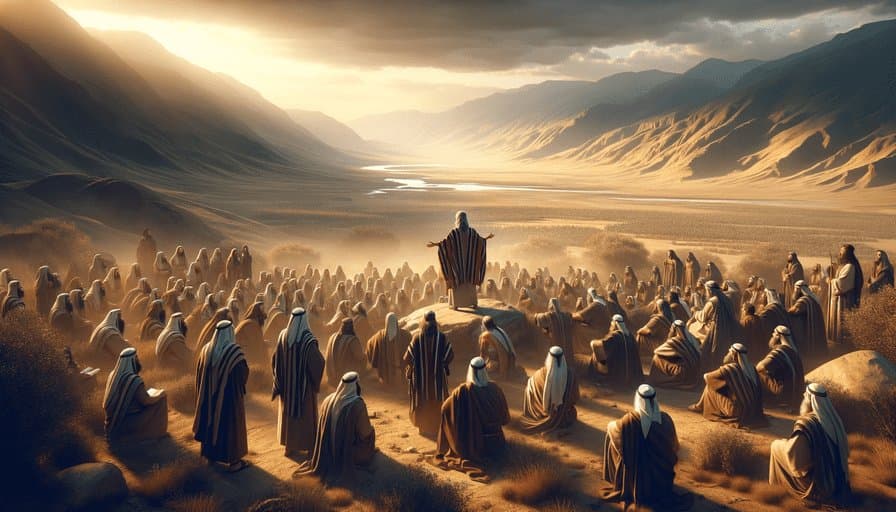
The parsha opens as Moshe (Moses) addresses all Israel on the plains of Moav (Moab), east of the Jordan, in the fortieth year after leaving Egypt. He speaks to a new generation, the children of those who left Egypt, and reviews everything that has happened since the nation stood at Chorev (Horeb), the mountain of Sinai. There God tells them they have stayed at the mountain long enough and that the time has come to journey toward the land promised to Avraham (Abraham), Yitzchak (Isaac), and Yaakov (Jacob). Moshe recalls how vast the people have already become, as numerous as the stars, and how the road to the Promised Land lies open before them.
Appointing Judges
Moshe recalls how the burden of leading so great a people grows too heavy for him to carry alone. On God's guidance he appoints wise and understanding leaders from each tribe, judges who can share the work of settling disputes and guiding the nation. He charges them to judge fairly, to hear small and great alike, and never to show favoritism or fear any person, because judgment belongs to God. In this way Moshe reminds the people that justice has always stood at the heart of their life as a nation.
The Sin of the Spies
Moshe recounts the painful episode that costs the previous generation the land. When Israel reaches the border, the people ask to send scouts ahead, and the men who go return frightened, spreading a report that the land cannot be conquered. The nation loses heart and weeps through the night, refusing to go up, and in doing so rejects the very gift God is offering. God decrees that this faithless generation will not enter the land but will wander in the wilderness for forty years until it passes away. When the people then try to force their way in against God's word, they are struck down, learning too late that victory comes only when God goes with them.
Years of Wandering
Moshe traces the long detour through the wilderness during those forty years. As the people skirt the lands of Edom, the descendants of Esav (Esau), and of Moav and Ammon, the descendants of Lot, God instructs Israel not to provoke these nations or seize their territory, since He has given those lands to them as their own inheritance. The account pauses to note the ancient peoples who once lived in those regions and were displaced in their turn, a quiet reminder that God directs the rise and fall of every nation. At last the wandering generation passes away, and a new one stands ready to move forward.
Sichon and Og
As Israel advances, Moshe recalls the first great victories on the eastern side of the Jordan. He sends messengers of peace to Sichon (Sihon), king of Cheshbon, but Sichon refuses passage and marches out to war, and God delivers him and all his land into Israel's hands. Then Og, the giant king of Bashan, comes against them with all his people, and he too is defeated, his fortified cities falling one after another. These triumphs show the new generation that the God who seemed distant during the years of wandering is now fighting openly on their behalf.
Dividing the Land
With the eastern territory secured, Moshe describes how he apportions it to the tribes of Reuven (Reuben), Gad, and half of Menashe (Manasseh), who will settle there. He makes them promise that their fighting men will cross the Jordan at the head of their brothers and not return home until all Israel has inherited the land. The parsha closes as Moshe turns to Yehoshua (Joshua), his successor, and strengthens him for the task ahead: he must not fear the kingdoms he is about to face, for God Himself will fight for Israel. With that charge, the stage is set for the conquest that lies just beyond the horizon.