
Pursue Justice
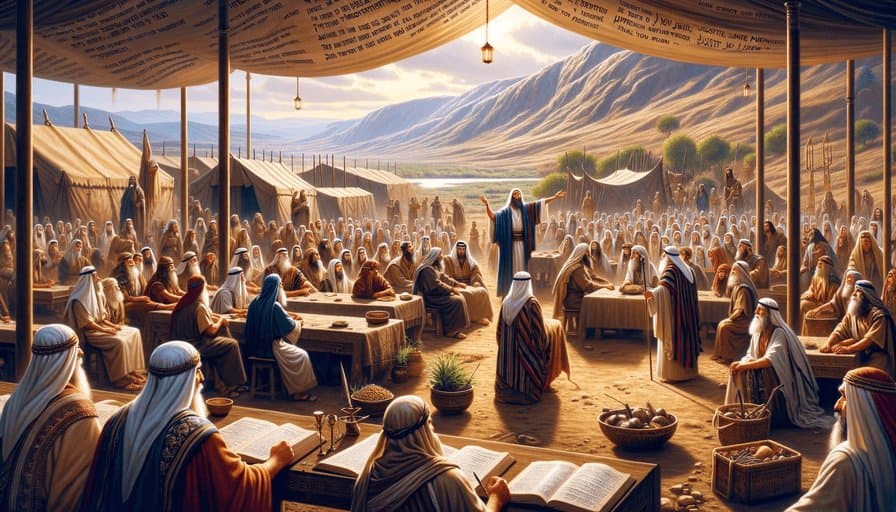
Moshe (Moses) commands the people to appoint judges and officers in all their gates and to judge with true righteousness, taking no bribe and showing no favor. He gives the ringing charge that becomes a motto for Jewish life: justice, justice you shall pursue. Alongside honest courts he forbids the idolatrous practices that corrupt worship, such as planting sacred trees or raising pillars beside God's altar. For the hardest cases, he establishes a high court at the place God will choose, whose rulings the whole nation must follow so the law stays unified and clear.
Kings and Priests
Moshe anticipates the day the people will want a king like the nations around them, and he permits it while setting firm limits on royal power. The king must be chosen by God from among his own people, and he must not amass horses, wives, or silver and gold, nor let his heart grow proud above his brothers. Above all he must write for himself a Torah scroll and read from it all his life, so that even the ruler remains a servant of God's law. Moshe then describes the priests and Levites, who receive no territory of their own but live from the gifts of the people, for God is their inheritance.
Prophets, Not Sorcerers
Moshe forbids the people to imitate the nations' ways of seeking hidden knowledge: no child sacrifice, no divination, sorcery, or consulting the dead, all of which are abominations to God. In place of these, God promises to raise up a prophet like Moshe from among the people, one who will speak God's true word, and the people are to listen to him. Moshe explains how to tell a genuine prophet from a false one: if a prophet's word does not come to pass, he has not spoken for God, and he need not be feared. Israel is to seek guidance not from magic but from God's own messengers.
Cities of Refuge
Moshe instructs the people to set aside cities of refuge, easy to reach, where a person who kills accidentally can flee and be safe from the avenging relative until the case is judged. He is careful to distinguish the unintentional manslayer, who deserves protection, from the deliberate murderer, who may claim no refuge. He forbids moving a neighbor's boundary marker to steal his land, and he lays down the law of witnesses: a matter stands only on the testimony of two or three, and a scheming false witness suffers the very penalty he sought to inflict on another. These laws surround both life and property with careful safeguards.
Going to War
Turning to war, Moshe tells the people not to fear an enemy greater than themselves, for God who brings them out of Egypt goes with them. A priest anointed for battle addresses the troops, and officers send home any man who has built a new house, planted a vineyard, or betrothed a wife but not yet begun to enjoy them, along with anyone whose fear might spread to others. When approaching a distant city, Israel must first offer terms of peace before laying siege, and even in war they may not cut down the fruit trees around a city, for the trees are not the enemy. War is bounded here by mercy and restraint.
The Unsolved Murder
The parsha closes with a haunting ritual for a body found slain in the open country, with no one knowing who is responsible. The elders of the town nearest the body bring a calf to an untilled valley, break its neck, and wash their hands over it, declaring that they did not shed this blood and did not stand by while it happened. They pray for atonement, so that the guilt of innocent blood does not rest upon the community. Even a death with no known killer, Moshe teaches, is not allowed to pass unnoticed, for every human life demands an accounting.