
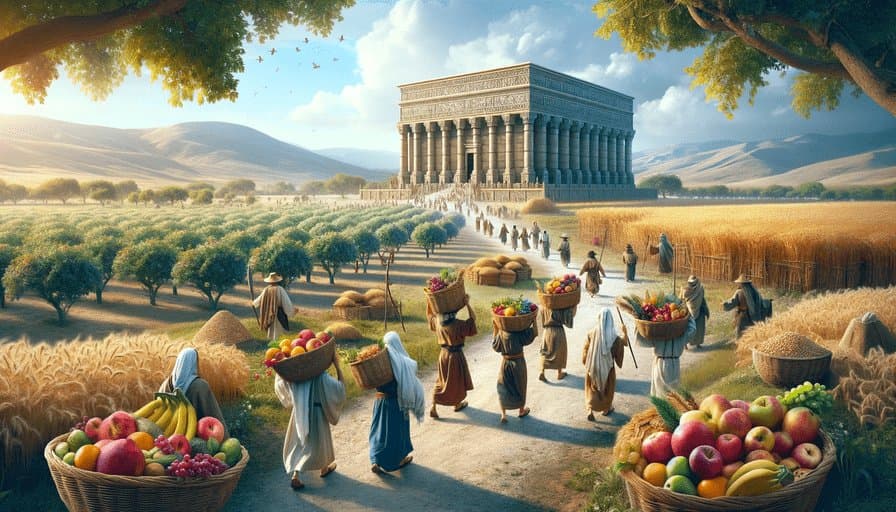
First Fruits
As Israel settles the land, each farmer is to take the first ripened fruits of the soil, place them in a basket, and bring them to the place God will choose. Presenting the basket to the priest, he recites one of the Torah's great declarations of gratitude, retelling in a few lines the whole journey of the people: how his ancestor went down to Egypt as a wandering stranger, how the family grew into a nation, how they cried out under slavery, and how God brought them out with a mighty hand to this land flowing with milk and honey. The offering turns a private harvest into an act of national memory and thanksgiving. Having received so much, the farmer rejoices before God together with the Levite and the stranger in his midst.
Tithes and Covenant
Moshe then describes the confession that accompanies the tithes of the third year, when a person affirms that he has faithfully given the sacred portions to the Levite, the stranger, the orphan, and the widow, holding nothing back. On the strength of that honesty he may ask God to look down and bless the people and the land. The passage rises to a mutual pledge: on this day Israel affirms God as its own, and God affirms Israel as a treasured people, lifted high above the nations in praise and glory. Two partners, in effect, choose one another.
Words on the Stones
Moshe and the elders command the people that, once they cross the Jordan, they are to set up large stones coated with plaster and inscribe upon them all the words of this Torah, plainly and clearly. They are to build an altar of unhewn stones on Mount Eval, bring offerings, and rejoice before God. Then comes a striking ceremony: six tribes stand on Mount Gerizim to face the blessing and six on Mount Eval to face the curse, while the Levites proclaim a series of solemn warnings against hidden sins such as idolatry, dishonoring parents, and perverting justice for the weak. To each, the entire people answer 'Amen,' binding themselves to a life of integrity even where no human eye can see.
The Blessings
Moshe lays out the abundance that follows when Israel truly listens to God's voice. Blessing will reach every corner of life: the city and the field, the fruit of the womb and the fruit of the land, the basket and the kneading bowl, coming in and going out. Enemies who rise up will scatter, the storehouses will be full, and Israel will lend to many nations and borrow from none, standing as the head and not the tail. These are not rewards won by bargaining, but the natural flowering of a society that lives in loyalty to God.
The Rebuke
The parsha then turns to the Tochacha (the Rebuke), a long and unflinching warning of what unfolds if the people abandon the covenant. Moshe does not soften the picture: he speaks of illness, drought, defeat, exile, and the terror of a nation that has lost its way, so that the words land with full weight. Yet the honesty is itself an act of love, for such a warning is spoken only to someone whose future still matters and can still be changed. The very fact that Israel is being told all of this, in advance and in detail, means the door to a better path remains wide open. The rebuke is meant not to crush hope but to awaken it.
Forty Years of Care
Moshe gathers all Israel and asks them to look back on everything their own eyes have witnessed: the wonders in Egypt, and forty years in the wilderness in which their clothes did not wear out and their sandals did not fall apart. God, he reminds them, sustained them without ordinary bread or wine so that they would come to know, deep down, that He alone is their God. He recalls how they defeated the kings Sichon (Sihon) and Og and settled tribes in the lands they conquered. The parsha closes with a plea to keep the words of this covenant and to carry them into everything they are about to do.