
If You Follow
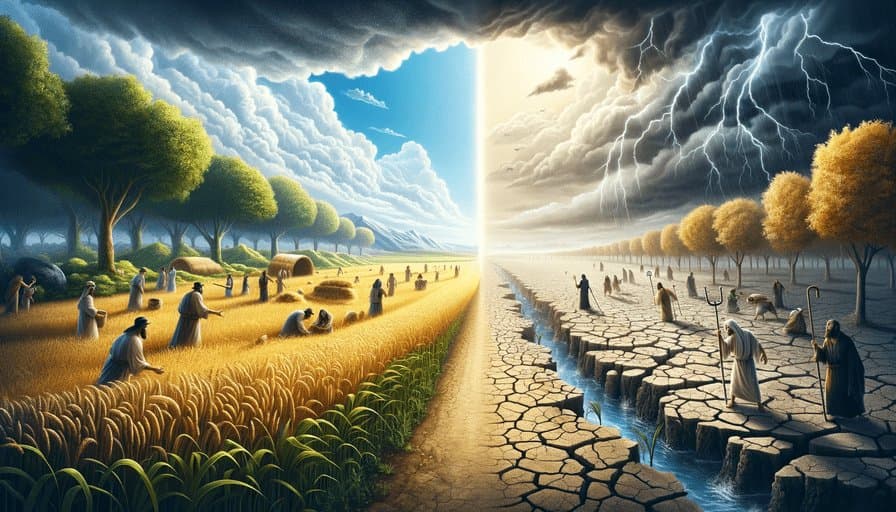
The parsha opens with a vision of what faithfulness brings. If Israel walks in God's statutes and keeps His commandments, the Torah promises rain in its season, fields and trees heavy with produce, and bread eaten to full satisfaction. There will be peace in the land, safety from wild beasts and enemies, and a people made fruitful and strong. Greatest of all is the promise that God will place His dwelling among them and walk in their midst, so that they are His people and He is their God.
The Rebuke
The tone then shifts into a long and difficult passage known as the tochacha (the rebuke). If Israel spurns the covenant and rejects God's laws, the Torah describes a rising tide of hardship that arrives in stages: illness and terror, drought and failed harvests, wild beasts, war, plague, and crushing siege. In the end the people are exiled from their land and scattered among the nations, while the soil they neglected finally lies desolate. The warnings are deliberately severe, meant not to crush the people but to awaken them to how much the covenant truly matters.
The Covenant Remembered
For all its darkness, the rebuke does not end in despair. God promises that when the exiled people confess their own wrongdoing and the wrongdoing of their ancestors and humble their stubborn hearts, He will remember His covenant with Yaakov (Jacob), Yitzchak (Isaac), and Avraham (Abraham). Even scattered among their enemies, Israel will not be so rejected as to be destroyed, for God will not break His covenant with them. The land will finally enjoy its long-denied rest, and the way home always remains open.
Vows and Valuations
After the covenant's promises and warnings, the parsha turns to vows freely made to God. A person may dedicate to the sanctuary the assessed value of a human life, an animal, a house, or a field, and the Torah lays out fair valuations along with the rules for redeeming what has been pledged. Some dedications can be bought back by adding a fifth of their value, while certain devoted things are set apart completely. These laws take the impulse of generosity seriously while keeping every pledge honest and grounded.
The Final Tithe
The parsha, and the whole Book of Leviticus, closes with the law of the tithe. A tenth of the produce of the land and of the flocks and herds belongs to God, a steady reminder that every harvest and increase ultimately comes from Him. As the animals pass beneath the shepherd's rod, every tenth one is counted holy. The book ends on the solemn note that these are the commandments God gave Moshe (Moses) for the people of Israel at Mount Sinai, sealing a book wholly devoted to the pursuit of holiness.