
Counting the People
In the second year after the Exodus, God tells Moshe to take a census of the Israelites, counting every man aged twenty and older who can serve in the army. A leader from each tribe assists, and the tribes are numbered one by one, reaching a total of 603,550. The count is not cold arithmetic: each person stands up to be recognized as part of the whole. By naming and numbering them, God treats a vast multitude as a community of individuals, each one seen and each one belonging.
Banners Around the Mishkan
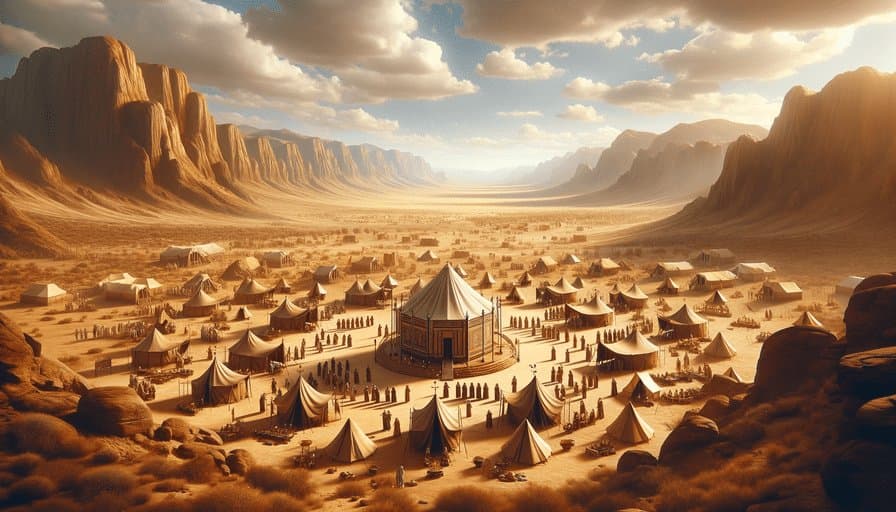
God then arranges the camp with careful order. The twelve tribes are grouped into four divisions of three, each division under its own banner, positioned to the east, south, west, and north of the Mishkan. The Sanctuary sits at the very center, with the Levites encamped immediately around it. The same arrangement sets the order of march when the people travel, so that wherever Israel goes, God's presence remains at the heart of the camp.
The Tribe of Levi
The Levites are counted separately from the rest of the nation, for they are not soldiers but servants of the Sanctuary. God appoints them to guard, carry, and care for the Mishkan and its holy vessels, working under Aharon (Aaron) and his sons, the priests. Set apart for sacred duty, the Levites belong to God in a special way. Their role is a reminder that a holy people needs those whose whole purpose is to tend what is holy.
Redeeming the Firstborn
God declares that the Levites will take the place of the firstborn of Israel, who were consecrated to divine service when God spared them in Egypt. The firstborn are counted, and where their number exceeds that of the Levites, the remainder are redeemed with a payment given to the priests. In this exchange, one group's calling is quietly passed to another. The moment shows how service to God can be entrusted, transferred, and carried on the shoulders of those chosen for it.
Carrying the Holy Things
The parsha turns to the family of Kehat (Kohath), the Levites charged with carrying the most sacred objects of the Mishkan. Because these items are so holy, Aharon and his sons must first cover the Ark, the table, the menorah, and the altars before the journey begins, so that the Kehatites never touch or gaze upon them directly. Handling holiness demands both closeness and reverent distance. The reading ends with this careful choreography, a people learning that even how they carry the sacred matters deeply.