
Kindling the Lamps
God instructs Aharon (Aaron) to kindle the lamps of the menorah so that they cast their light toward the center of the Sanctuary. The Torah then describes how the Levites are purified and formally dedicated to their service, offered up on behalf of all Israel in place of the firstborn. With the light lit and the Levites installed, the final preparations for the journey fall into place. The Sanctuary is ready, and so are those who will tend it.
A Second Passover
As the anniversary of the Exodus arrives, the people bring the Pesach (Passover) offering in the wilderness. But some men who were ritually impure cannot take part and come to Moshe asking why they should be left out. Rather than turn them away, Moshe brings their question to God, who establishes Pesach Sheni, a second Passover one month later for anyone unable to observe the first. It is a striking lesson that a sincere longing to draw close can open a real second chance.
Cloud and Trumpets
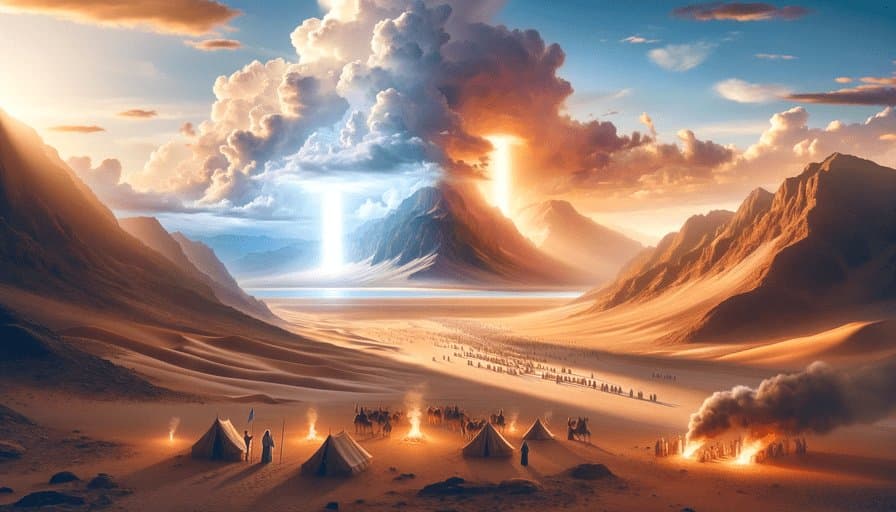
A cloud rests over the Mishkan (Tabernacle) by day and a fire glows over it by night. When the cloud lifts, the people journey; when it settles, they camp, waiting however long it remains. God also tells Moshe to fashion two silver trumpets to summon the people, sound the alarm, and mark the festivals. Between the cloud and the trumpets, Israel learns to move only at God's signal, trusting that every step and every stop is guided from above.
Leaving Sinai
At last the cloud lifts, and for the first time the people set out from Sinai in their marching order, tribe by tribe, with the Ark going before them. Moshe invites Chovav, his relative by marriage, to journey onward with them and share in the good that lies ahead. As the Ark travels, Moshe calls out the ancient words asking God to rise up and scatter His enemies, and when it rests he welcomes God back among the multitudes of Israel. The great journey to the Promised Land has finally begun.
The Craving for Meat
Almost as soon as they travel, the people begin to complain, and a fire breaks out at the edge of the camp until Moshe prays and it subsides. Then a craving spreads: they weep for meat and remember the food of Egypt, wearied of the manna that falls each day. Overwhelmed, Moshe cries out that he cannot carry this people alone, and God answers by resting His spirit on seventy elders to share the burden of leadership. God sends vast flocks of quail, but the craving turns deadly, and the place is named for the graves of those who hungered.
Miriam and Moshe
In the parsha's final scene, Miriam and Aharon speak against Moshe concerning his wife, questioning whether he alone hears God's word. God calls all three to the Tent and declares that while He speaks to other prophets in visions, with Moshe He speaks mouth to mouth, for Moshe is the humblest of all people. Miriam is struck with tzara'at, a whitening of the skin, and Moshe pleads with a short and heartfelt prayer for God to heal her. She is kept outside the camp for seven days, and the whole nation waits for her before traveling on to the wilderness of Paran.