
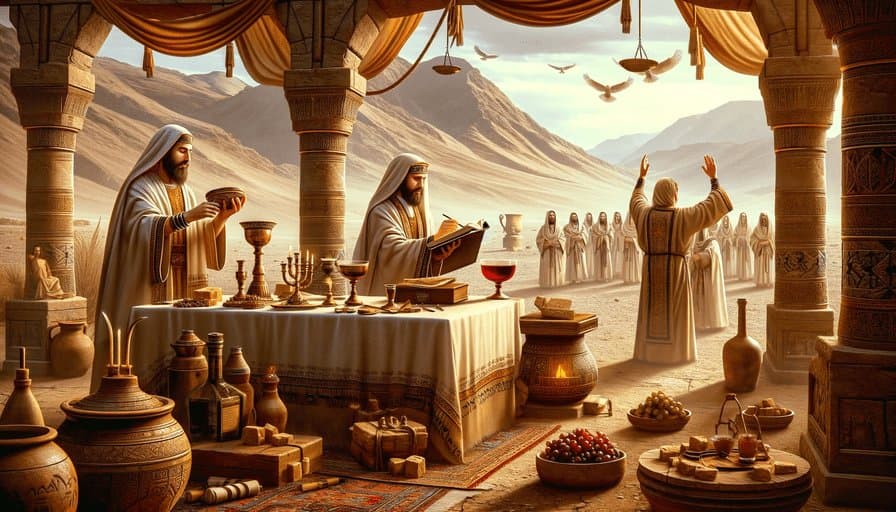
The Levites' Burdens
The reading opens by completing the census of the Levite families begun in the previous parsha. God tells Moshe (Moses) to number the sons of Gershon and the sons of Merari and to assign them their tasks: carrying the curtains, coverings, boards, and pillars of the Mishkan whenever the people travel. Each family bears its own portion of the sacred load. Together they ensure that God's dwelling can be taken apart, carried, and raised again at every stage of the journey.
Guarding the Camp
God commands that those who are ritually impure be sent outside the camp for a time, so that the place where His presence dwells stays pure. The Torah then turns to honesty between people: one who wrongs another must confess, make restitution, and add a fifth to what was taken. Purity of the camp is not only physical but moral. A holy community depends on clean hands and truthful hearts as much as on ritual boundaries.
The Suspected Wife
The parsha describes the ritual of the sotah, a wife whose husband suspects her of unfaithfulness when there are no witnesses to settle the matter. She is brought to the priest and given special waters to drink that are meant to reveal the truth, either clearing her name or confirming the betrayal. Behind the striking ceremony lies a deep concern for trust, jealousy, and peace within a marriage. Tradition even notes that God allows His own holy name to be erased in the waters for the sake of restoring harmony between husband and wife.
The Nazirite Vow
Next comes the law of the nazir, a person who takes a vow of special holiness for a set time. A Nazirite abstains from wine and grapes, lets the hair grow uncut, and avoids all contact with the dead. When the term is complete, the Nazirite brings offerings and returns to ordinary life. The vow offers a path to rise higher through self-restraint, yet the Torah also asks the Nazirite to bring a sin offering, hinting that holiness is found not in denying life's gifts but in sanctifying them.
The Priestly Blessing
God gives Aharon (Aaron) and his sons the words with which they are to bless the people of Israel: that God will bless and protect them, shine His face toward them with grace, and grant them peace. These three short verses have been spoken over Jewish communities and children ever since. Though the priests pronounce the words, the Torah makes clear that it is God who blesses. The kohanim are only the channel through which that blessing flows.
Gifts of the Princes
The parsha closes with the dedication of the Mishkan, as the leader of each of the twelve tribes brings an offering. First they present wagons and oxen to help carry the Sanctuary, and then, over twelve days, each prince offers an identical set of gifts for the altar. The Torah lists every prince's offering in full, one after another, even though they are the same. In doing so it teaches that each tribe's contribution is precious in its own right, and the reading ends as God's voice speaks to Moshe from above the Ark, between the two cherubim.