
Scouting the Land
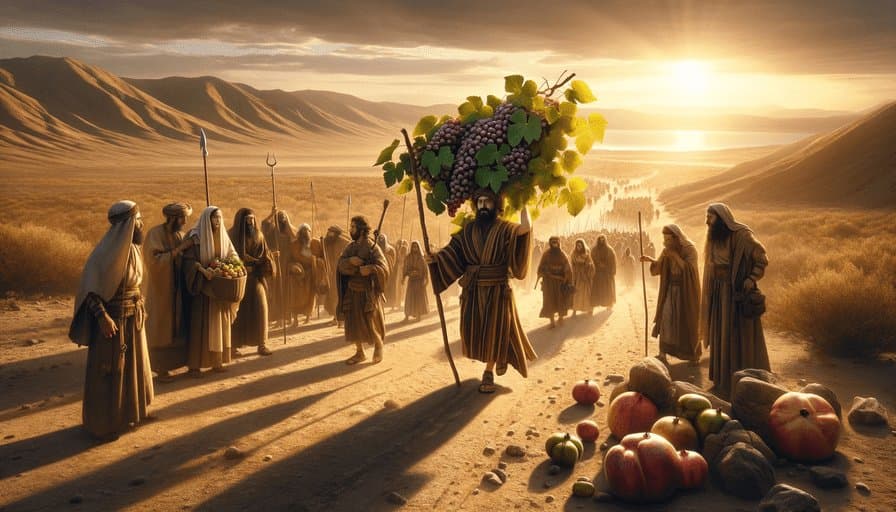
God tells Moshe (Moses) to send twelve men, a leader from each tribe, to scout the land of Canaan. They travel through it for forty days, seeing its cities and its people and cutting a single cluster of grapes so large it must be carried on a pole between two men. The land is indeed rich, flowing with milk and honey, just as God had promised. The scouts return carrying its fruit, and the whole nation gathers to hear what they have found.
The Evil Report
Ten of the scouts admit the land is bountiful but insist it cannot be conquered: the cities are fortified, the inhabitants are giants, and next to them the scouts felt like grasshoppers. Only Kalev (Caleb) and Yehoshua (Joshua) disagree, urging the people to trust that God will bring them in. Kalev silences the crowd and declares that they are well able to go up and take the land. But the frightening words of the majority have already taken hold of the people's hearts.
A Night of Weeping
The people break down in tears, crying that they should have died in Egypt and even proposing to appoint a new leader to take them back. Yehoshua and Kalev tear their garments and plead with the nation not to rebel against God, but the crowd threatens to stone them. God's presence appears at the Tent, and He speaks of destroying the people entirely. Moshe intercedes, appealing to God's patience and boundless kindness, and asks Him to forgive as He has forgiven so many times before.
Forty Years of Wandering
God forgives the people but decrees that the generation which refused the land will not enter it. For each of the forty days the scouts spent in the land, Israel will wander a year in the wilderness, until all that generation has passed on. Only Kalev and Yehoshua, who trusted God, will live to enter. The ten scouts who spread the evil report die in a plague, and when a group defies the decree and tries to storm the land on their own, they are struck down. The dream of immediate entry is gone, deferred to the children who will grow up in the desert.
Laws for the Land
The reading softens into laws that assume a future in the land, a quiet promise that the story is not over. God gives instructions for the wine and flour offerings that will accompany sacrifices, and for setting aside a portion of dough, the challah, when baking bread. There are offerings to atone for sins committed in error, whether by the community or an individual. The Torah also records the grave case of a man who deliberately gathers wood on Shabbat, a reminder that the holiness of the day is not to be treated lightly.
The Fringes of Memory
The parsha ends with the mitzvah of tzitzit, the fringes that Israel is commanded to place on the corners of their garments, with a thread of blue among them. Looking at the fringes, a person is to remember all of God's commandments and to keep them, rather than being led astray by the wandering of the eyes and the heart. Coming right after the failure of the scouts, who looked at the land and lost faith, the tzitzit teach a wiser way of seeing. This passage became the third paragraph of the Shema, recited every day.