
Balak's Fear
After Israel's victories over the Amorite kings, Balak (Balak) son of Tzippor, king of Moav (Moab), is seized with dread at the sight of so vast a nation encamped nearby. Believing he cannot prevail against them in battle, he decides to fight them with spiritual weapons instead. He sends a delegation of elders to summon Bilam (Balaam) son of Beor, a gentile prophet famed for the power of his blessings and curses, promising him great honor to come and curse Israel. God warns Bilam not to go, but when Balak sends a second, more distinguished delegation, God permits him to travel on the strict condition that he speak only the words God gives him.
The Angel and the Donkey
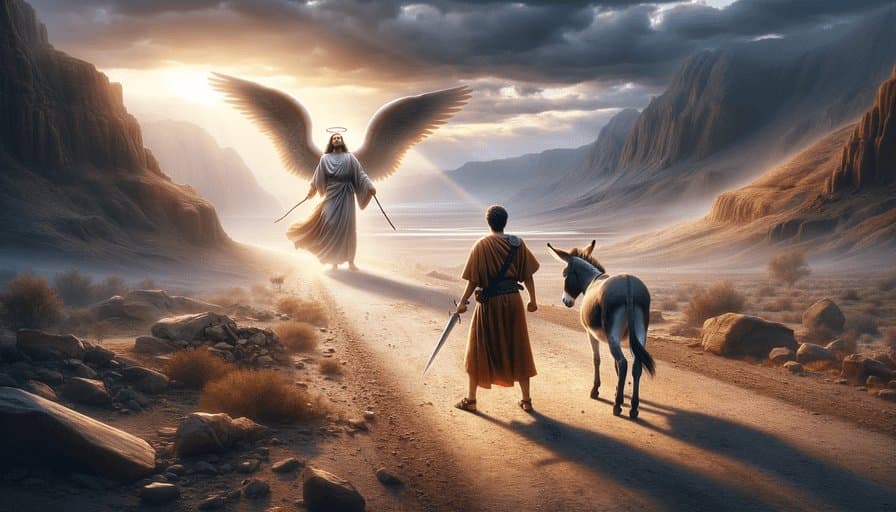
Bilam saddles his donkey and sets out, and God's anger flares at his eagerness. An angel of God stands in the road with a drawn sword, invisible to Bilam but plainly seen by his donkey, who swerves aside, presses against a wall, and at last simply lies down. Bilam strikes the animal three times in frustration, and God opens the donkey's mouth to protest the beatings, turning the celebrated seer into a man outdone by his own beast. Then God opens Bilam's eyes to behold the angel, who repeats the warning that Bilam may say nothing except what he is told. The famed master of speech is put firmly in his place before he ever reaches Balak.
Blessing After Blessing
Balak greets Bilam and leads him to a height overlooking the Israelite camp, where they build altars and offer sacrifices in preparation for the curse. But when Bilam opens his mouth, only blessing comes forth: he describes a people set apart and beyond counting. Balak, dismayed, moves him to a second vantage point and then a third, hoping a new view will change the outcome, yet each attempt yields richer praise than the last. Bilam blesses Israel's tents and encampments with the words Jews still say each morning, Mah tovu ohalecha Yaakov, how goodly are your tents, O Yaakov (Jacob).
A Star from Jacob
With the spirit of God upon him, Bilam lifts his gaze toward the distant future. He foresees a star rising from Yaakov and a scepter from Israel, a promise of leadership and triumph in days to come. He pronounces the fate of Moav, Edom, Amalek, and the surrounding nations, his oracles ranging far beyond anything Balak had wanted to hear. His mission a complete failure, Bilam returns home, and Balak departs in anger, his gold spent on praise for the very people he sought to destroy.
The Sin at Peor
What Balak could not accomplish through Bilam soon nearly happens through seduction. The men of Israel are enticed by the women of Moav and Midian, share in their feasts, and bow to the idol Baal Peor, and a plague erupts in the camp. When an Israelite prince brazenly brings a Midianite woman before Moshe (Moses) and the weeping assembly, Pinchas (Phinehas) son of Elazar (Eleazar) seizes a spear and strikes them both, and the plague is stopped, though twenty-four thousand have already fallen. The portion closes here, on the toll of the plague, leaving Pinchas's reward for the reading that follows.