
The Rebellion Rises
Korach, a cousin of Moshe and Aharon, leads a revolt together with Datan and Aviram of the tribe of Reuven and two hundred fifty respected leaders of the community. They confront Moshe and Aharon with a bold accusation: the entire congregation is holy, so why do the two of them raise themselves above everyone else? Beneath the language of equality lies a grasp for power and priesthood. Moshe falls on his face, then proposes a test to let God Himself show whom He has chosen.
The Test of the Fire-Pans
Moshe tells Korach and his followers to each take a fire-pan, fill it with incense, and offer it before God in the morning, so that God will make known who is truly holy. He then summons Datan and Aviram, but they refuse to come and hurl bitter accusations at him instead. Moshe, who has given his whole life to this people, is deeply pained and insists he has never taken anything from anyone. The stage is set for a confrontation that will settle the challenge once and for all.
The Earth Opens
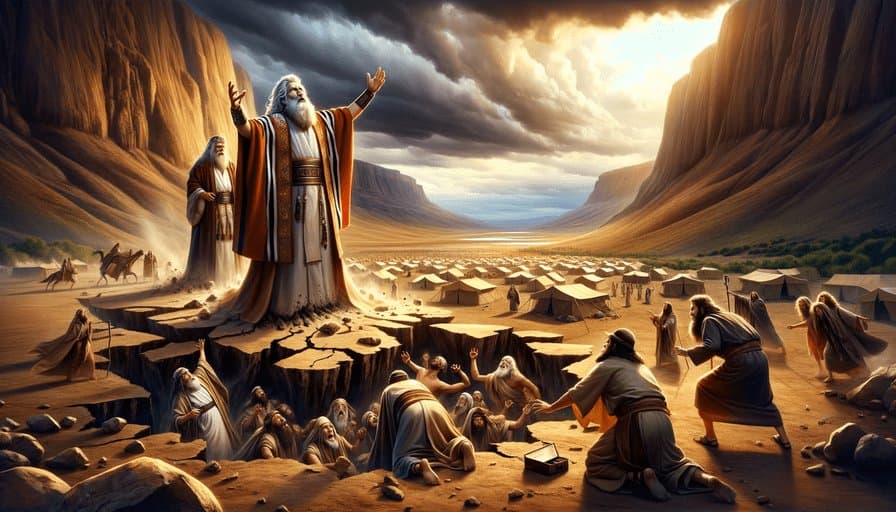
The next day the rebels gather with their fire-pans at the entrance of the Tent. Moshe declares that if these men die an ordinary death, then God has not sent him, but if the earth opens to swallow them, then they have spurned God. No sooner are the words spoken than the ground splits apart and swallows Korach's household along with Datan and Aviram, while a fire consumes the two hundred fifty men offering incense. Their fire-pans are hammered into a covering for the altar, a lasting warning that no outsider should presume to seize the priesthood.
Plague and Blossom
Instead of being chastened, the people accuse Moshe and Aharon of killing God's followers, and a deadly plague breaks out among them. Aharon, at Moshe's urging, runs into the midst of the people with his incense and stands between the dead and the living until the plague halts. Then God settles the question of leadership gently: the staff of each tribe is placed in the Sanctuary overnight, and Aharon's staff alone blossoms and bears ripe almonds. The staff is kept as a sign to quiet the complaints for good.
Gifts of the Priesthood
With the priesthood affirmed, God details the responsibilities and rewards of those who serve. The priests are charged to guard the Sanctuary and are granted portions of the offerings for their households. The Levites, who have no share of land, receive the people's tithes in return for their service, and they in turn set aside a tithe of what they receive as a gift to the priests. The roles Korach coveted are shown to be not privileges to grab but sacred duties, each with its own burden and its own blessing.