
The Long Way Around
As Israel leaves Egypt, God chooses not to lead them along the short coastal road through the land of the Philistines, lest the sight of war frighten them into running back to slavery. Instead He guides them by a roundabout desert path toward the Sea of Reeds. Moshe (Moses) carries out an ancient vow by taking the bones of Yosef (Joseph) for burial one day in the promised land. God travels before the people in a pillar of cloud by day and a pillar of fire by night, so they can journey at any hour.
Trapped at the Sea
No sooner has Israel gone than Par'oh regrets freeing them and races after them with his chariots and army. The people find themselves pinned between the advancing Egyptians and the sea, and in their terror they cry out and turn on Moshe, saying it would have been better to serve Egypt than to die in the wilderness. Moshe answers that they need only stand firm and watch, for God will fight for them. God then tells Moshe to stop his prayer and command the people to move forward.
The Sea Splits
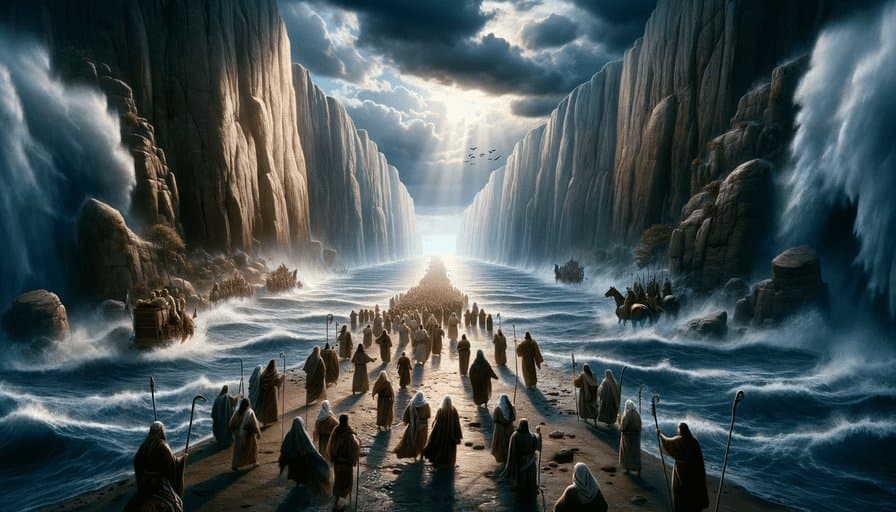
Moshe stretches out his hand over the water, and God drives the sea back with a strong east wind all night, turning it into dry land with walls of water standing on either side. Israel walks through the midst of the sea in safety, while the pillar of cloud shifts behind them to shield them from Egypt. When the Egyptians charge in after them, their chariot wheels jam and the returning waters crash down, drowning the whole army of Par'oh. Israel stands safe on the far shore and sees the great power of God, and the people come to believe in Him and in Moshe His servant.
The Song at the Sea
Overflowing with awe and gratitude, Moshe and the people of Israel break into song, praising God as a mighty deliverer who has hurled horse and rider into the sea. The Song at the Sea celebrates the downfall of the oppressor and looks ahead to the day God will plant His people on His holy mountain. Miriam the prophetess, sister of Moshe and Aharon (Aaron), takes a timbrel in her hand, and all the women follow her with drums and dancing. It is a burst of pure joy before the long road of the wilderness begins.
Bitter Water and Bread from Heaven
The joy soon meets the hard realities of the desert. At a place called Marah the people find only bitter water, and when they complain God shows Moshe a tree to cast in that turns the water sweet. Later, hungry and afraid, the people long for the food of Egypt, and God rains down manna, a fine mysterious bread from heaven that they gather fresh each morning. A double portion falls on Friday so that none need be gathered on Shabbat, teaching the people to rest and to trust that each day's needs will be met.
Water from the Rock
Journeying onward, the people again find no water and quarrel bitterly with Moshe, demanding to know whether God is truly among them or not. Moshe cries out to God, afraid the people are almost ready to stone him. God tells him to strike a rock at Chorev, and when he does, water streams out for the whole camp to drink. The place is named for the people's testing and strife, a lasting reminder of how quickly gratitude can slide into doubt.
The War with Amalek
The parsha ends with a sudden attack by Amalek, who falls upon Israel in the wilderness. Moshe sends Yehoshua (Joshua) to lead the fighters while he himself climbs a hill and lifts his hands, and as long as his hands are raised Israel prevails. When his arms grow heavy, Aharon and Chur support them on either side until sunset, and Yehoshua overcomes Amalek in battle. God declares that He will be at war with Amalek in every generation, and Moshe builds an altar of thanks, closing the parsha with the sober truth that hard-won freedom must still be defended.