
A Gift from the Heart
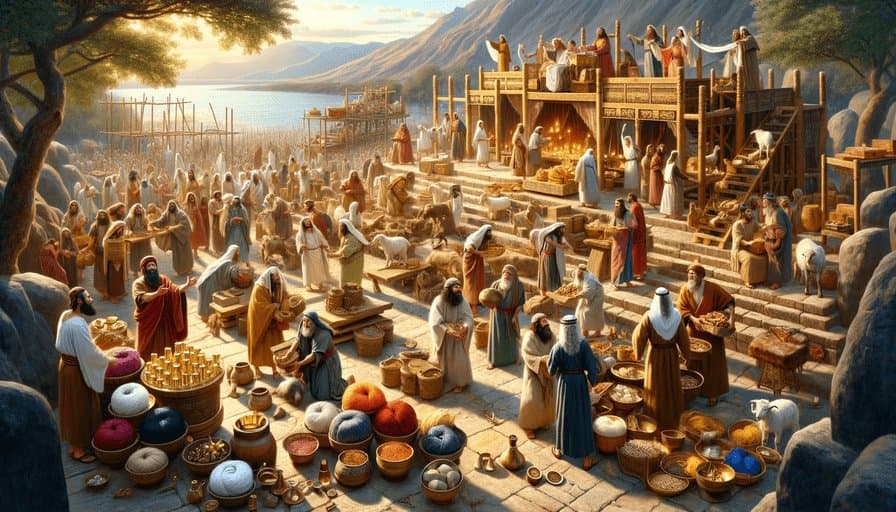
God tells Moshe (Moses) to invite the people of Israel to bring a contribution, a terumah, for the building of the Sanctuary, but only from those whose hearts move them to give. The materials are many: gold, silver, and copper, richly dyed wool and fine linen, goat hair and animal skins, oil, spices, and precious stones. Then God states the heart of the whole project, that the people should make Him a Sanctuary so that He may dwell among them. The dwelling is not for God's sake, who fills all space, but so that His presence can be felt in the midst of the camp.
The Ark and the Cherubim
The instructions begin with the most sacred vessel, the Aron (the Ark), a gold-covered chest that will hold the tablets of the covenant. Upon it rests a solid gold cover crowned by two keruvim (cherubim), winged figures facing one another with the sense of a divine embrace. From the space between these cherubim, God tells Moshe, He will speak and give His commands to Israel. This innermost vessel becomes the meeting point between God and His people.
Table and Lamp
Next comes the Shulchan (the Table), a gold-covered table of acacia wood on which a special showbread is set before God at all times. Facing it stands the Menorah (the lampstand), hammered from a single block of pure gold, with a central shaft and six branches shaped into cups, knobs, and almond blossoms. Its lamps are to give light within the Sanctuary continually. Together the table and the lamp fill the holy space with sustenance and light.
The Dwelling Itself
The Torah then describes the structure of the Mishkan as a whole. Beautiful tapestry curtains of linen and colored wool are joined into one great covering, layered over with curtains of goat hair and then protective coverings of skins. The walls are formed from upright acacia beams overlaid with gold, standing in sockets of silver and held firm by horizontal bars. Piece by piece, a portable dwelling takes shape that can be assembled and carried wherever Israel journeys.
Curtain and Altar
Within the Sanctuary a special woven curtain, the Parochet (the dividing curtain), screens off the innermost chamber where the Ark rests as the Holy of Holies. A second screen hangs at the entrance to the tent itself. Outside, in the open courtyard, stands the great Mizbeach (the altar) of acacia wood overlaid with copper, fitted with horns at its corners and all the tools for the offerings. Here, before the dwelling, the service of sacrifice will be carried out.
The Courtyard
Finally the Torah lays out the chatzer, the courtyard that surrounds the Mishkan. Hangings of fine linen, held up by pillars set in sockets, enclose a sacred rectangle, with a screen serving as its gateway. This boundary marks off holy ground from the ordinary space of the camp, giving the Sanctuary a dignified setting. With the courtyard defined, the plan for a place where heaven and earth can meet is complete.