
Locusts and Darkness
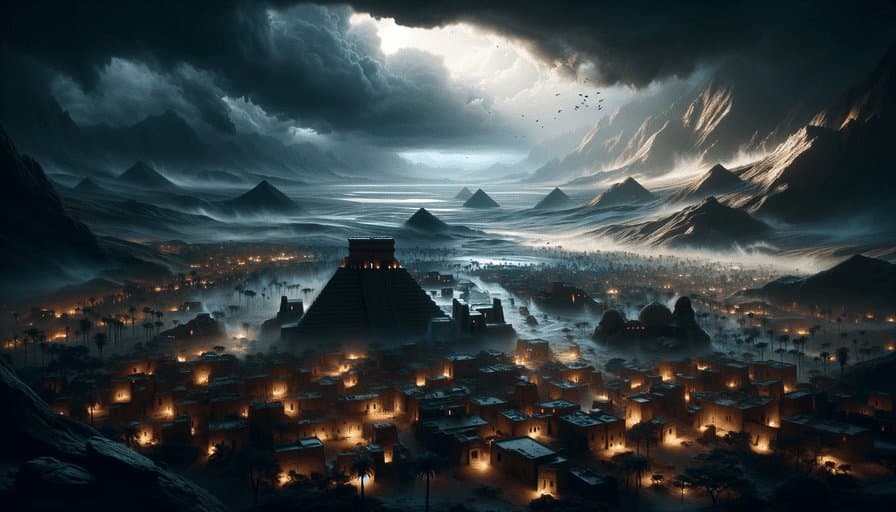
Bo opens with the eighth plague as Moshe (Moses) warns Par'oh of a swarm of locusts so vast it will devour whatever the hail has left. Par'oh's own servants plead with him to relent, but he offers only a partial release and then refuses, so the locusts descend and strip the land bare. Next comes a ninth plague, a darkness so thick it can be felt, blanketing Egypt for three days while the people of Israel have light in their homes. Hardened still, Par'oh warns Moshe never to see his face again.
The Final Warning
Before the last blow falls, Moshe delivers God's most solemn warning: at midnight every firstborn in Egypt will die, from the heir of Par'oh to the child of the lowest servant, and even the firstborn of the animals. A great cry will rise across the land such as has never been heard, yet among Israel not even a dog will bark. Moshe leaves Par'oh in burning anger, knowing the king still will not listen. The stage is set for the night that will change everything.
A New Beginning
Now, on the very edge of freedom, God gives Israel its first commandment as a nation: to mark the new moon and make this month the head of the year. From this moment the people are to be masters of their own sacred calendar, no longer slaves whose time belongs to others. It is a striking way to begin a redemption, not with a weapon but with the gift of holy time. Freedom, the Torah hints, starts with taking charge of how we live our days.
The Pesach Offering
God then commands the details of the first Pesach. Each household is to take a lamb, and on the appointed night to place its blood on the doorposts and lintel as a sign. Inside, the family eats the roasted lamb together with matzah (unleavened bread) and bitter herbs, dressed and ready to travel in haste. That night God will pass through Egypt in judgment but pass over the marked homes of Israel, and the people are told to keep this service in every generation as a memorial of their deliverance.
The Night of Redemption
At the stroke of midnight God strikes down every firstborn in Egypt, and a great cry goes up, for there is not a house without someone dead. Par'oh rises in the night and at last sends Israel away, begging them to go and even to bless him. The people leave in such haste that their dough has no time to rise, so they carry it as matzah, while the Egyptians press gold, silver, and garments upon them. After four hundred and thirty years, a vast throng of six hundred thousand men, along with their families and a mixed multitude, marches out of Egypt as a free people.
Signs for the Generations
The parsha closes with laws meant to carry this night down through the ages. God commands that every firstborn of Israel be set apart for Him, redeemed in memory of the firstborn spared in Egypt. Parents are told to recount all of this to their children, so the story is retold in each generation as though every person had come out of Egypt. And the people are to bind these truths as a sign upon the hand and between the eyes, the origin of tefillin, keeping the Exodus close in word and in deed.