
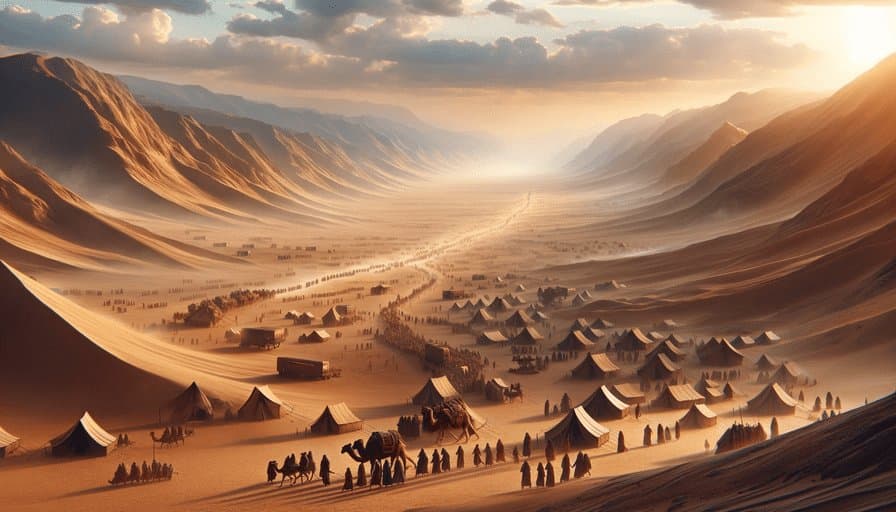
Retracing the Journey
The portion opens with Moshe (Moses) recording, at God's command, the complete itinerary of Israel's travels from the Exodus to the plains of Moav (Moab). Forty-two encampments are named in order, each marking a place where the people paused, camped, or endured hardship across the long desert years. This written record stands as a memorial to the entire wilderness journey and to God's guidance at every stage of the way. Looking back over the whole route, the reader sees a nation carried step by step from slavery toward the edge of the Promised Land.
Clearing the Land
God then instructs the people that once they cross the Jordan into Canaan, they are to drive out its inhabitants and destroy their idols, altars, and high places. The Land is to be apportioned among the tribes by lot, larger tribes receiving more and smaller tribes less. God warns that any inhabitants left in place will become thorns in Israel's sides and snares to its faith, drawing the nation toward corruption. The command makes clear that settling the Land is not only a physical conquest but a spiritual responsibility.
Borders of the Land
God lays out the borders of the Land of Canaan, tracing its boundaries on the south, west, north, and east so that Israel will know exactly the inheritance it is receiving. He appoints Elazar (Eleazar) the priest and Yehoshua (Joshua) son of Nun, together with a designated leader from each tribe, to oversee the fair division of the territory. This careful mapping transforms a long-promised hope into a concrete homeland with real borders and named custodians. The generation encamped at the Jordan can finally picture the land that awaits them.
Cities of Refuge
Because the tribe of Levi is given no territory of its own, the Israelites are commanded to grant the Levites forty-eight cities dispersed among all the tribes. Six of these are set apart as cities of refuge, where a person who kills another by accident may flee for safety from the victim's avenging kin. The Torah sharply distinguishes intentional murder, which carries the death penalty, from accidental killing, whose perpetrator remains protected in the city of refuge until the death of the High Priest. These laws honor the sanctity of every human life while restraining the impulse toward private vengeance.
Keeping the Inheritance
The Book of Numbers ends by returning to the five daughters of Tzelophchad (Zelophehad), whose right to inherit their father's land had already been granted. The leaders of their tribe now worry that if the sisters marry into another tribe, their portion will be lost to their ancestral tribe forever. God affirms the daughters' inheritance but rules that they marry within their own tribe, so that no tribe's land passes permanently to another. The sisters wed their cousins, the tribal inheritances are preserved, and Sefer Bemidbar closes with Israel poised by the Jordan, ready to enter the Land.