
All of You Stand
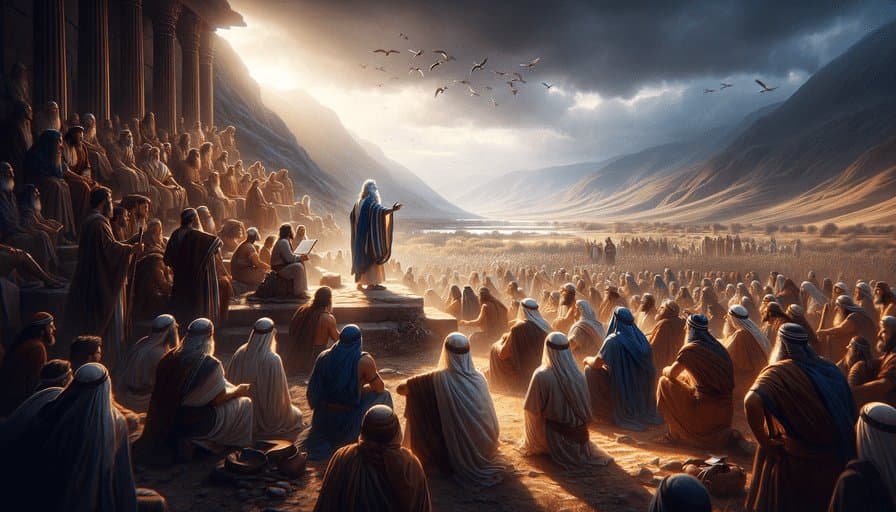
Moshe opens by telling the people that they are all standing this day before God to enter into His covenant: the heads of the tribes and the elders, the men, the women, and the children, down to the woodcutter and the water drawer. No one is too great or too small to belong. Strikingly, he adds that the covenant is made not only with those physically present, but with all who are not there that day, reaching across time to bind future generations as well. Every Jew who would ever live is, in a sense, standing at that assembly.
The Hidden and the Revealed
Moshe warns the people not to let any root among them bear the bitter fruit of idolatry, and cautions against the person who hears the covenant yet privately assures himself that he may follow his own stubborn heart and still be at peace. Such quiet betrayal, he says, cannot simply be waved away. He paints a sobering image of a land laid waste, which later nations will look upon and understand as the cost of abandoning God. He then draws a careful line: the hidden things belong to God alone, while the things revealed belong to us and to our children, to live by faithfully.
The Promise of Return
Here the parsha turns luminous. Moshe foresees a time when all these things, the blessing and the curse alike, have come upon the people and they find themselves scattered among the nations. When they take it to heart there and turn back to God with all their heart and soul, he promises, God will gather them from the ends of the earth, bring them home, and even circumcise their hearts so they can love Him fully. This is teshuvah (return to God) at its most hopeful: no distance is too great, and no exile is ever final.
Not Far Off
Moshe insists that the commandment he is giving is neither too hard nor beyond reach. It is not in the heavens, that one should wonder who will ascend to bring it down, nor across the sea, that one should ask who will cross to fetch it. Rather, he says, it is very near: in your mouth and in your heart, so that you can actually do it. The life of Torah is not reserved for a distant few but placed within the grasp of every ordinary person.
Choose Life
Moshe gathers all of this into one of the Torah's most stirring appeals. He calls heaven and earth as witnesses and sets before the people life and good, death and evil, telling them plainly to choose life so that they and their children may live. To choose life is to love God, to listen to His voice, and to hold fast to Him, who is their length of days upon the land. The decision, and the blessing that flows from it, rests in their own hands.