
After Childbirth
The double portion opens with the woman who has given birth, marking a period of ritual impurity and then a longer time of purification as she stands at the very threshold of life and death. When those days are complete she brings an offering, with a gentler path of two birds provided for those of limited means. The Torah also notes that a son enters the covenant through circumcision on the eighth day. These laws surround the awesome moment of birth with quiet dignity rather than treating it as anything to hide.
The Signs on the Skin
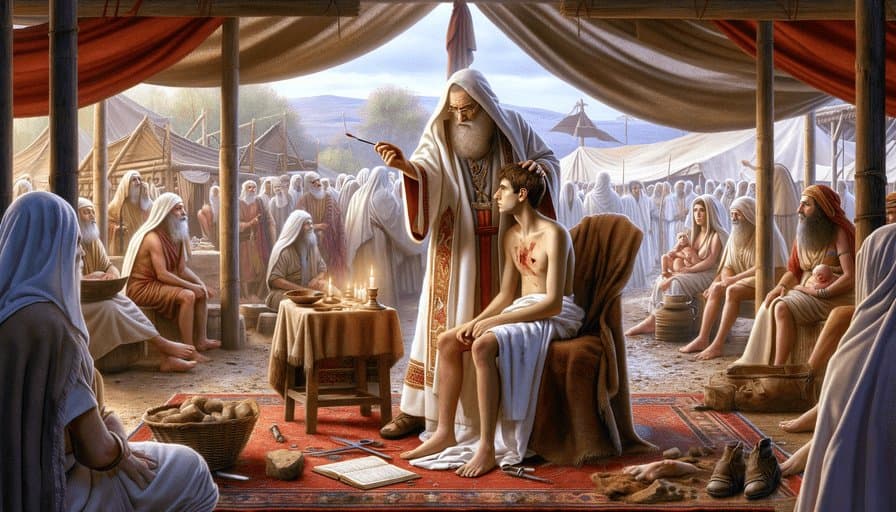
Most of the first portion is given to tzara'at, an affliction that surfaces as a discoloration or swelling on the skin. The person is brought to the Kohen (priest), whose careful eye alone can pronounce them pure or impure, and who may set them apart for seven days and look again before deciding. The tradition understands this affliction not as ordinary illness but as an outward sign of inward matters, often connected to harmful speech. One found to bear it lets his hair grow, tears his garments, and dwells alone outside the camp, set apart for honest reckoning yet never abandoned by the community that awaits his return.
Cloth and Its Stains
Before turning to healing, the Torah describes tzara'at that appears in a garment of wool, linen, or leather. The Kohen examines the greenish or reddish mark, sets the garment aside, and watches whether it spreads, then washes, tears, or burns it as the case requires. That an affliction of the spirit can leave its trace even on what a person wears widens the reach of the parsha's message. What stirs within us, it suggests, can imprint itself on the world we carry with us.
The Road Back
The second portion opens with the return of the metzora, the one who has borne this affliction, in a ritual of striking gentleness. The Kohen goes outside the camp to meet him, taking two birds, cedar wood, a crimson thread, and hyssop; one bird is offered and the other, dipped in its blood, is set free to fly across the open field. After washing, shaving, and immersing, the person waits and then brings offerings on the eighth day, with blood and oil placed upon the ear, thumb, and toe, and a gentler offering allowed for the poor. Every step is designed to welcome a person back into the fullness of life and community.
A House Afflicted
The Torah then describes tzara'at that can appear in the very walls of a house once the people have entered their land. The owner tells the Kohen, who examines the greenish or reddish depressions in the stones and closes up the house for seven days. Affected stones are removed and replaced, and if the affliction returns the house itself is dismantled; if it does not, the home is purified with the same rite of two birds. Even a person's dwelling, the parsha teaches, can become a summons to look honestly at how one lives within it.
Purity of the Body
The double portion closes with the states of purity that accompany the body's natural discharges, both ordinary and irregular, for men and for women, including the times surrounding a woman's monthly cycle. The Torah treats these rhythms of life with straightforward dignity, marking their passing states of impurity and the immersion and offerings that restore purity. The section ends by naming its purpose: that Israel be kept mindful of impurity so as not to defile the sanctuary in whose midst God dwells. Holiness, these portions insist, is lived in the body and the home, not only in the sanctuary.