
The Reckoning
The parsha opens with a careful accounting of every material donated for the Sanctuary: the totals of gold, silver, and copper, and exactly how each was used. The silver, gathered from the half shekels of the census, becomes the sockets that anchor the walls, while the gold and copper are shaped into vessels and fittings. This public reckoning leaves no room for suspicion about the treasures placed in Moshe's care. Even in service of the holy, the Torah models complete honesty and transparency.
The Priestly Garments
Attention turns to the garments for those who will serve in the Sanctuary. The artisans weave the ephod, the breastplate set with twelve engraved stones, the robe of bells and pomegranates, the tunics, and the golden headplate inscribed Holy to God. At each stage the Torah repeats that the work is done exactly as God commanded Moshe. The clothing that will dress Aharon (Aaron) and his sons in dignity is finished down to the last thread.
The Work Is Done
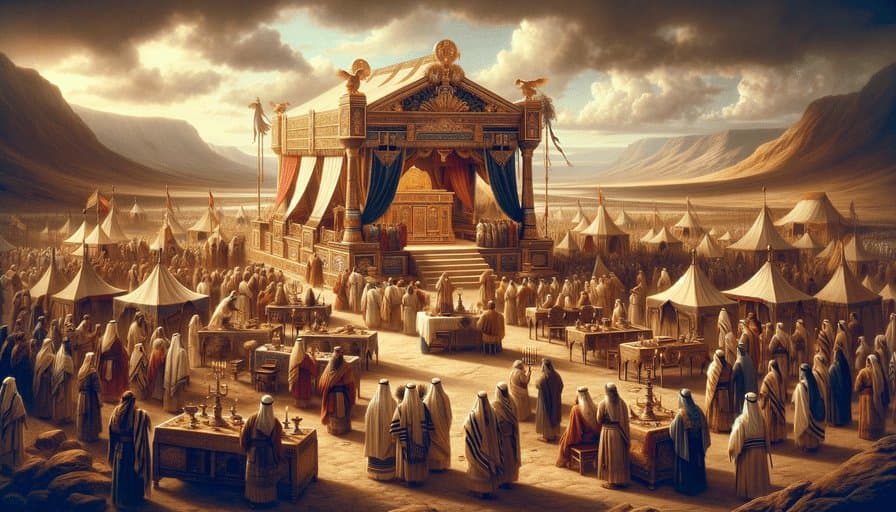
With every component complete, the people bring the entire Sanctuary to Moshe: the tent and its coverings, the vessels, the altars, and the garments, each piece laid before him. Moshe inspects all of it and sees that they have done everything precisely as God commanded, and he blesses the people for their labor. After the fracture of the golden calf, the nation stands united again around a task fulfilled. The blessing seals a moment of wholeness and repair.
Command to Raise It Up
God speaks to Moshe with instructions for setting up the Sanctuary. It is to be erected on the first day of the first month, Nisan, and each part put in its place: the Ark behind the curtain, the Table and Menorah, the altars, the washstand, and the courtyard around them. Moshe is to anoint the Sanctuary and its vessels to make them holy, and to dress and consecrate Aharon and his sons for their service. Everything is prepared for the Sanctuary to begin its life.
Moshe Raises the Mishkan
On the first of Nisan, one year after leaving Egypt, Moshe raises up the Mishkan with his own hands. He sets the boards in their sockets, spreads the tent, places the Ark with the tablets inside, and arranges the Table, the Menorah, and the golden altar, kindling the lamps and offering the incense. He hangs the screen at the entrance, sets the copper altar and washstand in the courtyard, and completes the enclosure. Again and again the Torah records that Moshe did each act just as God had commanded him.
The Glory Fills the Sanctuary
When the work is finished, a cloud settles over the Tent of Meeting and the glory of God fills the Mishkan, so overwhelming that even Moshe cannot enter. From that day on, the cloud rests upon the Sanctuary by day and a fire glows within it by night, visible to all Israel. When the cloud lifts, the people journey onward, and when it settles, they camp. So the Book of Exodus closes with God visibly dwelling among His people, ready to lead them home.