
Shabbat First
Moshe assembles the entire community and, before a single beam is raised, reminds them of Shabbat. Six days are given for work, but the seventh is holy, a day of complete rest on which even the sacred labor of the Sanctuary must cease, and no fire may be kindled. By placing Shabbat first, the Torah teaches that building for God never overrides the boundaries God has set. Holiness in time comes before holiness in space.
A Willing Heart
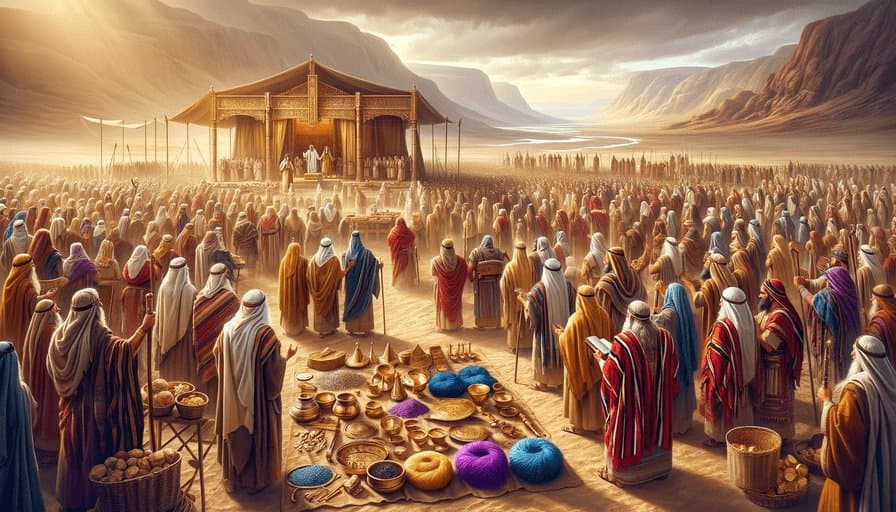
Moshe invites everyone whose heart moves them to bring gifts for the Sanctuary: gold, silver, and copper, richly dyed wool, fine linen, animal skins, oil, spices, and precious stones. Men and women come streaming forward, the women spinning yarn with their own hands and the leaders bringing the costly gems and oils. Every gift is a free offering, given out of love rather than obligation. A nation recently steeped in sin now discovers the joy of giving for something holy.
Wisdom to Build
Moshe announces that God has singled out Betzalel (Bezalel) and Oholiav (Oholiab), filling them with wisdom, insight, and craft, and with the gift of teaching others. Skilled workers gather around them and set to work on every part of the Sanctuary. So freely do the people keep donating that the artisans tell Moshe there is already more than enough, and he has to send word through the camp for the giving to stop. It is a rare and beautiful problem: generosity that must be restrained.
The Sanctuary Rises
The craftsmen begin with the structure itself. They weave the great tapestries of the Mishkan, join them into coverings, and layer the protective outer curtains of goat hair and skins over the top. Standing wooden boards overlaid with gold are fitted into silver sockets to form the walls, and a richly woven curtain, the paroches, is hung to screen off the innermost chamber where the Ark will rest. Board by board and curtain by curtain, the dwelling place takes shape.
Sacred Furnishings
Betzalel himself crafts the holiest vessels. He builds the Ark of gold to hold the tablets, its cover crowned by two keruvim (cherubim) with outstretched wings, and fashions the golden Table for the showbread and the pure gold Menorah hammered from a single piece. He also makes the golden altar for incense and blends the sacred anointing oil and the fragrant incense. Each vessel is wrought with care, ready for the day the Sanctuary will come alive with service.
Altar and Courtyard
The work moves outward to the courtyard. Betzalel makes the large copper altar for the offerings and the copper washstand, formed from the polished mirrors donated by the women. Around the whole Sanctuary he sets up an enclosure of linen hangings on posts, with a woven screen for its gateway. With the courtyard complete, every physical component of the Mishkan now stands ready to be assembled.