
The Eternal Flame
The parsha opens with a command for the people to bring pure, pressed olive oil for the light of the Sanctuary. Aharon and his sons are charged with kindling this ner tamid, the continual lamp, so that it burns from evening until morning in the Tent of Meeting. The steady flame stands just outside the curtain that screens the Ark, a constant sign of God's nearness. Tending it becomes one of the priesthood's first and most enduring duties.
Garments of Glory
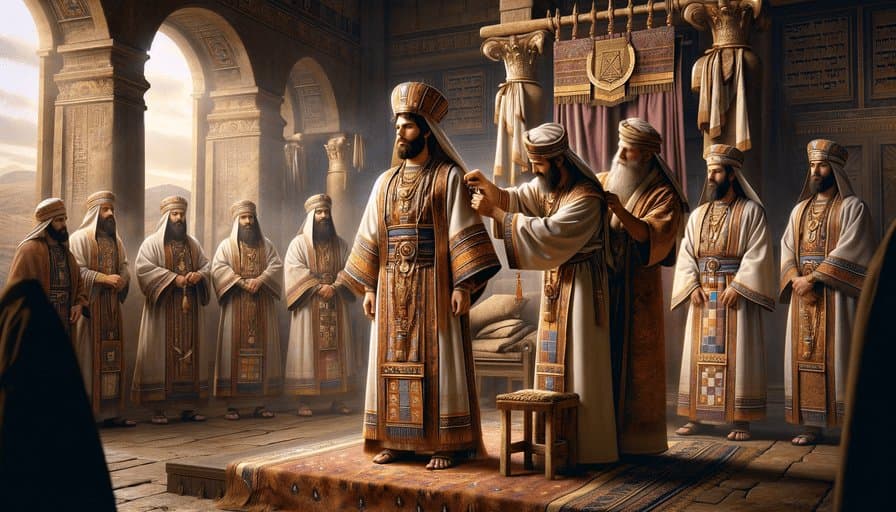
God then commands that special garments be made for Aharon and his sons, woven by skilled artisans for honor and for beauty. Aharon, who will serve as the Kohen Gadol (High Priest), is given eight garments, while his sons receive four each. Among them are the ephod, a woven vestment of gold, blue, purple, and crimson; the robe of sky blue ringed with golden bells and cloth pomegranates that chime as he moves; and a golden band across the forehead engraved with the words Holy to God. These clothes are not mere decoration: they mark the wearer as set apart for sacred service and lend beauty to the worship of God.
The Breastplate
The most intricate garment is the choshen, the breastplate of judgment, worn over the heart. Set into it are twelve precious stones in four rows, each engraved with the name of one of the tribes of Israel, so that Aharon carries all the people before God whenever he enters the holy place. Folded within the breastplate are the Urim and Tumim, through which God's guidance can be sought at moments of great national decision. In this way the Kohen Gadol never stands alone: he bears the whole nation upon his heart.
Seven Days of Consecration
God then describes the elaborate ceremony that will install Aharon and his sons into the priesthood. Over seven days they are washed, dressed in their garments, and anointed with oil, and offerings are brought to purify the altar and atone for them. Blood is placed upon the ear, thumb, and toe of each priest, dedicating their hearing, their action, and their step to God's service. Through this weeklong rite the sons of Aharon are transformed into servants fit to approach the holy.
The Daily Offering
The parsha turns to the offering that will anchor each day in the Sanctuary: a lamb brought every morning and a second lamb every afternoon, together with flour, oil, and wine. This continual offering, the korban tamid, frames the rhythm of worship from dawn to dusk. God promises that through this service He will meet with Israel and dwell in their midst, and that they will know Him as the God who brought them out of Egypt. The purpose of the whole Sanctuary shines through here: not the building for its own sake, but a God who chooses to dwell among His people.
The Golden Altar
Finally God commands the making of a small golden altar for incense, to stand inside the Sanctuary before the curtain of the Ark. Every morning and evening, as Aharon tends the lamps, he burns fragrant incense upon it, sending up a quiet cloud of devotion alongside the light. Once a year its corners receive special atonement on Yom Kippur, marking it as most holy. With this altar the instructions for the Sanctuary and its service draw toward completion.