
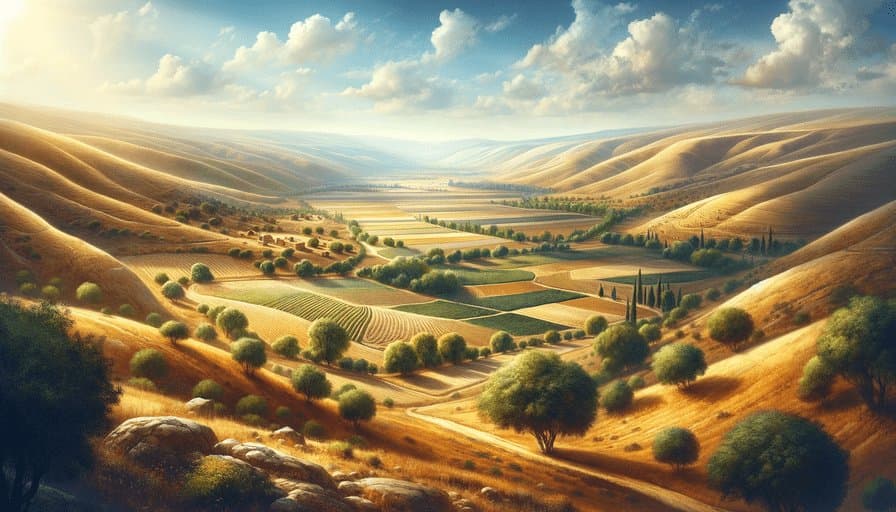
The Land's Sabbath
At Mount Sinai, God gives the land of Israel its own Sabbath. For six years the fields are worked, but every seventh year is a shemitah (a sabbatical year) in which the land rests completely and whatever grows on its own is left free for all to eat. The soil is not merely a possession to be drained but a trust to be honored. This rhythm of work and release mirrors the Sabbath given to human beings, extending the principle of sacred rest to the earth itself.
Jubilee and Redemption
Every fiftieth year brings the Yovel (the Jubilee), when the shofar sounds on Yom Kippur (the Day of Atonement), liberty is proclaimed, ancestral land returns to its families, and servants go free. Because the land belongs to God and is only leased until the Jubilee, its sale is priced fairly and can be reversed by a redeeming relative. The parsha then commands a deep care for the neighbor who grows poor: strengthen him, lend to him without interest, and never treat him as a slave, for all Israel are God's servants whom He freed from Egypt. Justice, dignity, and freedom are woven directly into life on the land.
Blessing for Faithfulness
The second portion opens with the rewards of loyalty. If Israel walks in God's statutes and keeps His commandments, the Torah promises rain in its season, land heavy with harvest, and fruit trees full to the branch. There will be peace in the land, safety from wild beasts and enemies, and a people who grow fruitful and secure. Above every material gift stands the greatest promise of all, that God will make His dwelling among them and walk in their midst, and they will be His people and He their God.
The Rebuke
The blessings give way to a long and sobering warning known as the tochacha (the rebuke). If Israel abandons the covenant, the Torah describes wave after wave of consequence: illness and fear, drought and failed harvests, wild animals, war and siege, and finally exile, with the land left desolate and the people scattered among the nations. Yet even here mercy endures, for God promises that if the exiled people confess their wrongdoing and humble their hearts, He will remember His covenant with Yaakov (Jacob), Yitzchak (Isaac), and Avraham (Abraham) and will not reject them utterly. The land will at last enjoy the rest it was denied, and the way back remains open.
Vows and Valuations
After the covenant's blessings and warnings, the parsha turns to voluntary vows made to the sanctuary. A person may pledge the assessed value of a human life, an animal, a house, or a field to God, and the Torah sets out fair valuations and the rules for redeeming what has been dedicated. Some gifts may be bought back with an added fifth of their worth, while certain consecrated things are set apart entirely. These laws honor the sincerity of a vow while keeping such promises grounded and just.
Sealing the Book
The double portion, and the entire Book of Leviticus, ends with the tithe. A tenth of the produce of the land and of the flocks and herds is holy to God, set aside as a steady acknowledgment that all increase flows from Him. The animal tithe passes under the shepherd's rod, and every tenth one is made sacred. The book closes with the quiet, weighty summary that these are the commandments God gave Moshe (Moses) for the people of Israel at Mount Sinai, sealing a book devoted to the pursuit of holiness.