
The Red Heifer
The portion opens with one of the Torah's most mysterious commands, the law of the parah adumah, the red heifer. Its ashes, mixed with fresh water, purify a person who has become impure through contact with death, restoring them to the camp and its holiness. Yet in a striking paradox, the very ones who prepare and sprinkle these purifying waters themselves become impure in the process. The Torah calls this a chok, a statute whose reason lies beyond full human grasp, inviting trust in God even where understanding runs out. It is a fitting gateway to a portion filled with the mystery of life, death, and divine will.
Water and Loss
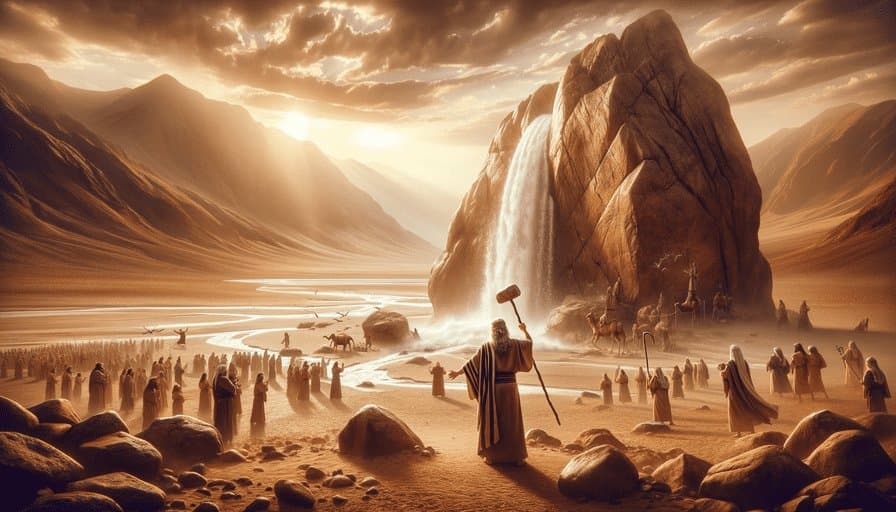
Miryam (Miriam), the prophetess and sister of Moshe (Moses) and Aharon (Aaron), dies at Kadesh, and at once the people find themselves without water. They quarrel bitterly, and God tells Moshe to speak to a rock so that it will give forth water before the whole community. Instead, in a moment of anger, Moshe strikes the rock twice, and though water gushes out, God tells him and Aharon that because they did not sanctify Him before the people, they will not lead Israel into the Land. The journey carries the people onward to Mount Hor, where Aharon dies and his son Elazar (Eleazar) takes up the priestly garments in his place. All Israel weeps for Aharon thirty days, mourning the gentle peacemaker who had guided them since Egypt.
Serpents and Song
Seeking the most direct route, Israel asks the king of Edom for safe passage, but he refuses and comes out against them, forcing a long detour. When the Canaanite king of Arad attacks and takes captives, the people vow themselves to God and win a decisive victory. Yet the hardships of the road wear on them, and they speak against God and against Moshe, complaining about the manna and the lack of water. In response venomous serpents come among the camp, and after the people repent, God tells Moshe to fashion a copper serpent and set it on a pole, so that all who look up toward it and toward Heaven are healed. Restored, the people journey onward singing the joyful Song of the Well, thanking God for the water that sustains them.
Kings of the Amorites
As Israel advances toward the Jordan, they request peaceful passage through the land of Sichon (Sihon), king of the Amorites, but he gathers his army and attacks. Israel defeats him and takes possession of his territory, then turns to face Og, the giant king of Bashan, who falls before them as well. These twin victories bring the eastern lands under Israel's control and fill the surrounding nations with dread. The portion pauses as the people encamp on the plains of Moav (Moab), across the Jordan from Jericho, poised at the threshold of the Promised Land.
Balak's Summons
Watching all this, Balak (Balak) son of Tzippor, king of Moav, is gripped by fear of the vast nation at his border. Convinced he cannot defeat Israel by the sword, he sends messengers to hire Bilam (Balaam) son of Beor, a renowned gentile prophet, to come and curse them. God warns Bilam not to go, then permits him on the condition that he speak only God's words, and Bilam sets out. On the way an angel of God, sword drawn, blocks the path, visible only to Bilam's donkey, who swerves and finally halts and speaks aloud in protest. God opens Bilam's eyes to see the angel, and he is told once more to say nothing but the words placed in his mouth.
Curses Turned to Blessing
Balak brings Bilam to three high places overlooking the Israelite camp, building altars and offering sacrifices, certain that from there the curse will finally come. But each time Bilam opens his mouth, blessing pours out instead of the curse Balak paid for. He praises a people dwelling securely and apart, as numberless as the dust, and utters the words Jews still recite each morning: Mah tovu ohalecha Yaakov, how goodly are your tents, O Yaakov (Jacob). Looking to the future, he foresees a star rising from Yaakov and a scepter from Israel, a vision of the nation's enduring destiny. Balak, furious that his plan has produced only praise, sends Bilam away empty-handed.
The Sin at Peor
The danger Balak could not achieve from outside soon comes from within. The men of Israel are drawn to the women of Moav and Midian, join in worshipping the idol Baal Peor, and a devastating plague breaks out in the camp. As the crisis rages, an Israelite prince openly brings a Midianite woman before the eyes of Moshe and the weeping people. Pinchas (Phinehas) son of Elazar rises up, takes a spear, and in a single decisive act of zeal for God halts the plague, though not before twenty-four thousand have died. The portion ends on this sobering note, the reward for Pinchas held back until the next reading.