
Shabbat and a Willing Heart
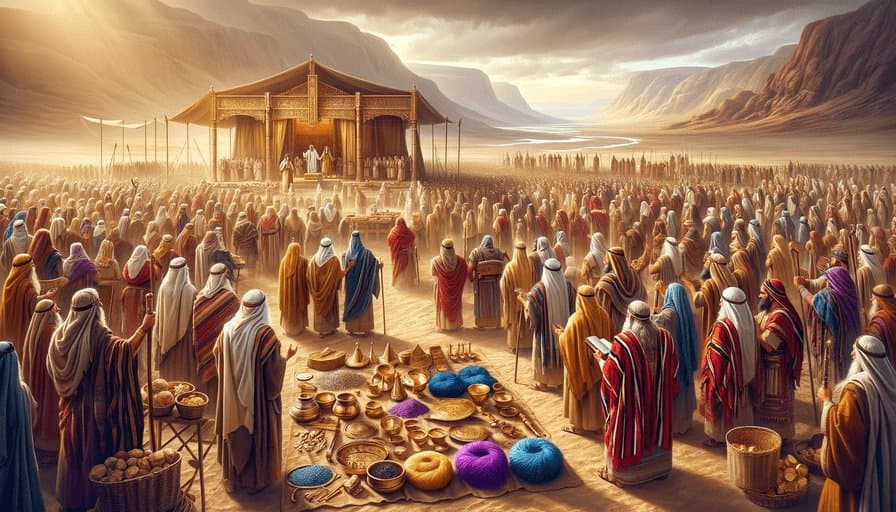
Moshe (Moses) gathers the whole community and begins, before any building, with Shabbat: six days for labor, but the seventh a holy day of rest that even the sacred work of the Sanctuary may not override. Then he calls for gifts, and the people respond with overwhelming generosity, bringing gold, silver, copper, dyed wool, fine linen, skins, oil, and precious stones. Men and women give freely from the heart, until the craftsmen report there is more than enough and Moshe must tell the people to stop. The nation that once gave its gold to a calf now pours it willingly into a home for God.
Wisdom to Build
God singles out two master craftsmen, Betzalel (Bezalel) of the tribe of Judah and Oholiav (Oholiab) of the tribe of Dan, filling them with wisdom, skill, and the gift of teaching others. Around them gathers a workshop of talented artisans, men and women alike lending their abilities to the holy task. Every willing hand finds a place in the work. What began as a divine blueprint now passes into human craft.
The Sanctuary and Its Vessels
The artisans build the structure itself: the woven tapestries and layered coverings of the tent, the gold covered boards set in silver sockets, and the curtain that screens the innermost chamber. Betzalel crafts the sacred vessels, the Ark with its cherubim, the Table for the showbread, the pure gold Menorah, and the golden altar for incense. Outside he makes the large copper altar and the washstand, formed from the mirrors the women donate, and encloses everything within a courtyard of linen hangings. Piece by piece, every part of the Mishkan is ready.
An Honest Accounting
As the second portion opens, the Torah pauses to give a full reckoning of the materials: the totals of gold, silver, and copper and exactly how each was used. The silver from the census half shekels becomes the sockets beneath the walls, while gold and copper are shaped into the vessels and fittings. This transparent accounting leaves no room for doubt about the treasures entrusted to Moshe. Even in the service of God, the Torah insists on complete honesty.
The Work Is Finished
The priestly garments are woven next, the ephod and jeweled breastplate, the robe of bells and pomegranates, and the golden headplate inscribed Holy to God, each made just as God commanded. At last the people bring the entire Sanctuary to Moshe, every board, vessel, and garment laid before him. He examines it all, sees that it has been done exactly as God commanded, and blesses the people for their faithful work. A nation once fractured by the golden calf now stands whole again around a task fulfilled.
The Glory Descends
On the first day of Nisan, a year after the exodus, Moshe raises up the Mishkan, setting each part in its place and consecrating Aharon (Aaron) and his sons for service, doing everything just as God had commanded. When the work is complete, a cloud settles over the Tent of Meeting and the glory of God fills the Sanctuary, so overwhelming that Moshe himself cannot enter. From then on the cloud rests upon it by day and fire by night, guiding Israel on their journeys. So the Book of Exodus ends with God dwelling visibly among His people.