
The Weight of a Vow
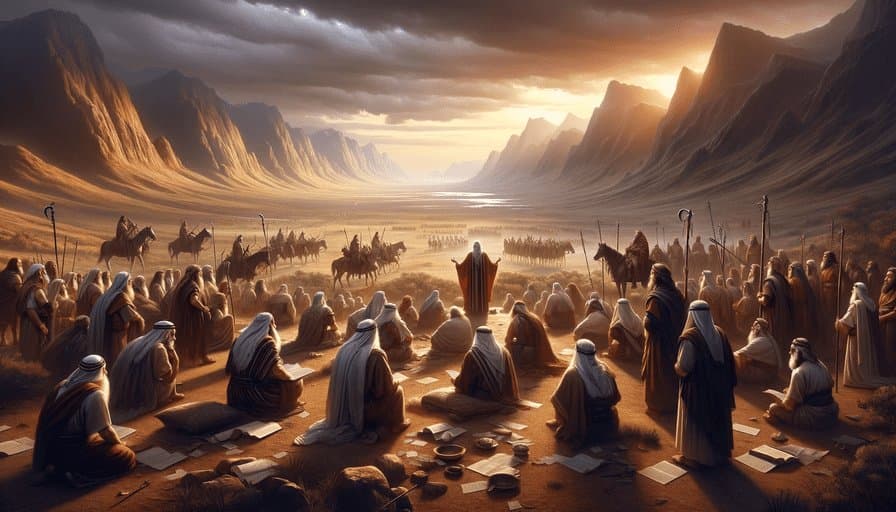
The double portion opens with Moshe (Moses) teaching the tribal heads the laws of vows. One who makes a vow or an oath must not break his word but must carry out everything he has spoken. The Torah spells out the limited cases in which a vow may be annulled, chiefly a father's power over the vows of his young daughter and a husband's over those of his wife, if he acts on the day he hears them. From the outset the portion underscores how seriously the Torah treats human speech and the promises we bind ourselves to.
War with Midian
God tells Moshe that before he dies he must carry out Israel's vengeance against Midian for the seduction at Peor. A thousand men from each tribe, twelve thousand in all, march to war alongside Pinchas (Phinehas) and the sacred vessels, and among the slain is Bilam (Balaam), whose counsel had ensnared Israel in sin. The soldiers return with captives and plunder, and Moshe directs that both the warriors and their metal spoils be purified through fire and water. The vast spoil is divided between the fighters and the community, with tribute set aside for God and the Levites, and the officers, having lost not one man, bring their captured gold as a thanksgiving offering.
Tribes Who Settle Early
The tribes of Reuven (Reuben) and Gad, rich in cattle, ask Moshe to receive their inheritance in the fertile grazing lands east of the Jordan rather than crossing into the Land itself. Moshe rebukes them sharply, fearing they mean to avoid the war and dishearten their brothers as the spies once did. They reassure him, pledging to send their armed men across the river at the head of the conquest and not to return until every tribe is settled. Moshe grants the request on that condition, and the lands of Gilad and Bashan are assigned to Reuven, Gad, and half the tribe of Menashe (Manasseh).
Forty-Two Journeys
Masei begins by looking back, as Moshe records the forty-two stages of Israel's travels from the day they left Egypt to their encampment on the plains of Moav (Moab). Each place of rest and hardship is named in turn, a written memorial of the long wilderness road and God's guidance through it all. God then commands the people, once they cross into Canaan, to drive out its inhabitants and destroy their idols and altars. He warns that any who are left will become thorns in Israel's side, a snare drawing the nation toward the very corruption of the Land.
Borders of the Land
God lays out the borders of the Land of Canaan that Israel is about to inherit, tracing its boundaries on every side. He appoints Elazar (Eleazar) the priest and Yehoshua (Joshua) son of Nun, together with a leader from each tribe, to oversee the fair division of the territory among the people. This careful mapping turns the long-promised Land from a distant hope into a concrete inheritance with real borders and named custodians. The generation poised at the Jordan can now picture the home that awaits them.
Cities of Refuge
Since the tribe of Levi receives no territorial portion, the Israelites are commanded to give them forty-eight cities to dwell in, scattered among all the tribes. Six of these are designated as cities of refuge, places where a person who kills another accidentally may flee for protection from the victim's avenging relative. The Torah carefully distinguishes deliberate murder, which carries the death penalty, from unintentional killing, whose perpetrator finds sanctuary until the death of the High Priest. These laws uphold the sacredness of human life while guarding against unchecked vengeance.
Keeping the Inheritance
The Book of Numbers closes by returning to the daughters of Tzelophchad (Zelophehad), whose right to inherit had been established earlier. Now the leaders of their tribe raise a concern: if the sisters marry into another tribe, their land will pass out of their father's tribe forever. God affirms their right to inherit but rules that they should marry within their own tribe so that no inheritance shifts from one tribe to another. The five sisters marry their cousins, the tribal lands remain secure, and Sefer Bemidbar ends with Israel encamped by the Jordan, ready at last to enter the Land.